



Chip boom drives Korea exports to new high
Mar 03, 2026, 09:24 am


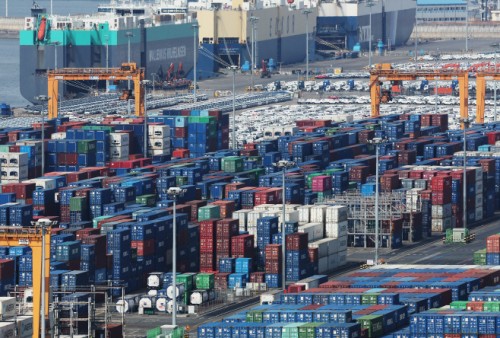 |
| Containers are stacked at Pyeongtaek Port in Gyeonggi Province on March 1, as South Korea’s February exports hit a record high. / Yonhap |
South Korea’s exports surged to a record high in February, driven by robust semiconductor shipments fueled by strong artificial intelligence demand.
According to the Ministry of Trade, Industry and Energy on March 2, exports reached $67.45 billion in February, up 29.0 percent from a year earlier — the highest figure ever recorded for the month.
Average daily exports jumped 49.3 percent on-year to $3.55 billion, surpassing the $3 billion mark for the first time. This came despite three fewer working days compared with the previous year due to the Lunar New Year holiday.
Imports rose 7.5 percent to $51.94 billion, resulting in a trade surplus of $15.51 billion — the largest on record for any month. Exports have now increased for nine consecutive months, while the trade balance has remained in surplus for 13 straight months since February 2025.
Semiconductors spearheaded the export rally. February chip exports soared 160.8 percent on-year to $25.16 billion, marking the highest monthly total ever. Shipments have exceeded $20 billion for three consecutive months.
The ministry attributed the surge to expanding AI-related investment and rising memory prices.
Memory chip prices climbed sharply compared with a year earlier. DDR4 8Gb rose from $1.35 to $13.00, DDR5 16Gb from $3.79 to $30.00, and NAND 128Gb from $2.29 to $12.67.
Computer exports jumped 221.6 percent to $2.56 billion, extending gains for five straight months, while wireless communication devices rose 12.7 percent to $1.47 billion. Mobile phone exports more than doubled, up 131.6 percent to $530 million.
Ship exports increased 41 percent to $2.2 billion, and biohealth products gained 7.1 percent to $1.31 billion, marking four consecutive months of growth.
In contrast, automobile exports fell 20.8 percent to $4.81 billion, and auto parts dropped 22.4 percent to $1.45 billion, largely due to reduced production during the holiday period.
Petroleum product exports edged down 3.9 percent to $3.73 billion despite higher volumes, as lower global oil prices weighed on unit prices. Petrochemical, steel and general machinery exports also declined.
By region, exports increased in seven of the nine major markets. Shipments to the United States rose 29.9 percent to $12.85 billion, a record for February. Exports to China climbed 34.1 percent to $12.75 billion, while exports to ASEAN advanced 30.4 percent to $12.47 billion — also February records. Exports to the European Union grew 10.3 percent to $5.6 billion.
Energy imports fell 1.4 percent to $9.29 billion, with crude oil imports down 11.4 percent. However, gas imports rose 15.9 percent. Non-energy imports, including semiconductors and chipmaking equipment, increased 9.6 percent to $42.64 billion.
The ministry said strong demand for high-value-added technology products, particularly chips linked to AI investment, continues to underpin Korea’s export momentum.
#South Korea exports #semiconductor exports #AI demand #trade surplus
Copyright by Asiatoday
Most Read
-
1
Celltrion’s Omlyclo gains ground in major European..

-
2
Trump demands rates fall below 1% as Fed hikes for..

-
3
Trump makes $1 trillion bet ahead of midterm elect..

-
4
Iran resumes ballistic missile production, assembl..

-
5
Trump warns countries not helping U.S. must pay re..

-
6
Apple launches first foldable, 1 million won prici..

-
7
Turkish Airlines named main club partner of Liverp..

PEOPLE







-
Address : In-Young Bldg., 34, Uisadang-daero 1-gil, Yeongdeungpo-gu, Seoul
Copyright by ASIATODAY CO., LTD. All rights resereved