



Amendment to restrict pardons faces constitutional concerns
Feb 23, 2026, 07:53 am


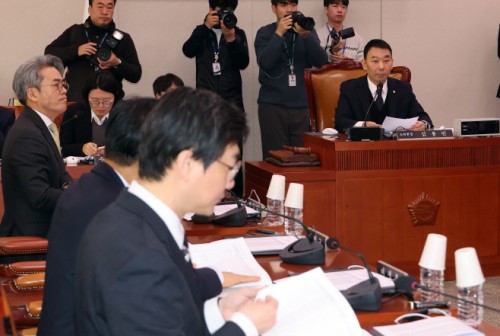 |
| Kim Yong-min, chair of the Legislation and Judiciary Committee’s Subcommittee on Bill Review I, presides over a meeting to review the amendment to the Amnesty Act at the National Assembly on Feb. 20. /Yonhap |
An amendment to the Amnesty Act that would bar pardons for those convicted of insurrection or treason has cleared a subcommittee of the National Assembly’s Legislation and Judiciary Committee, but legal experts warn it may infringe on the president’s constitutional authority.
The bill, led by the Democratic Party of Korea and other ruling bloc lawmakers, passed the committee’s Bill Review Subcommittee I on Feb. 20. It prohibits the president from granting pardons to individuals convicted of insurrection or foreign exchange-related crimes, unless at least three-fifths of all sitting lawmakers consent.
The amendment would apply the restriction to both general and special pardons.
The Constitution states that “the president may grant amnesty, commutation and restoration of rights as prescribed by law,” clearly designating pardon power as a presidential prerogative. It also requires National Assembly consent only in the case of general amnesties.
Critics argue that making parliamentary approval a condition even for exceptional cases effectively allows the legislature to intervene in the core decision-making authority of the president. They note that pardons are not merely legal acts but also instruments of political judgment and social integration, requiring broad public consensus.
Jang Young-soo, professor emeritus at Korea University Law School, said that unlike positions such as the prime minister or Supreme Court justices — which require parliamentary consent — some presidential appointments are respected as independent powers. “The president’s authority should not be restricted by statute,” he said.
Others contend the amendment runs counter to the fundamental legislative principle that laws should apply to unspecified persons and cases. The current Amnesty Act distinguishes only between general amnesty, targeting those who committed crimes, and special amnesty, targeting those who have been sentenced — without limiting eligibility by specific crime categories.
Cha Jin-ah, a professor at Korea University Law School, said specifying particular crimes as ineligible for pardon “unconstitutionally restricts the president’s pardon power” and could be viewed as “retaliatory legislation aimed at specific individuals.”
There are also concerns about retroactive application if the amendment were to affect ongoing trials. Former Presidents Chun Doo-hwan and Roh Tae-woo, who were sentenced to life imprisonment and other terms in 1997 on charges including insurrection, were released on special pardons about eight months after their convictions.
Rep. Na Kyung-won of the People Power Party said during a press conference after the subcommittee session that applying the law to cases currently under trial could violate the constitutional ban on retroactive legislation. She added that if such a prohibition were enacted, it should also apply to any crimes committed by President Lee Jae-myung.
Professor Jang also noted that ensuring consistent application to unspecified future cases may prove difficult, raising further constitutional questions.
#National Assembly #Amnesty Act #Kim Yong-min #Democratic Party of Korea #People Power Party
Copyright by Asiatoday
Most Read
-
1
Celltrion’s Omlyclo gains ground in major European..

-
2
Trump demands rates fall below 1% as Fed hikes for..

-
3
Hyundai Motor Group breaks ground on integrated st..

-
4
U.S. strikes 3 Iranian oil tankers, Iran vows reta..

-
5
Trump makes $1 trillion bet ahead of midterm elect..

-
6
Iran resumes ballistic missile production, assembl..

-
7
Samsung Electronics, Mistral AI to jointly develop..

PEOPLE







-
Address : In-Young Bldg., 34, Uisadang-daero 1-gil, Yeongdeungpo-gu, Seoul
Copyright by ASIATODAY CO., LTD. All rights resereved