



Kim Kun-hee probe suffers another courtroom defeat
Feb 10, 2026, 08:16 am


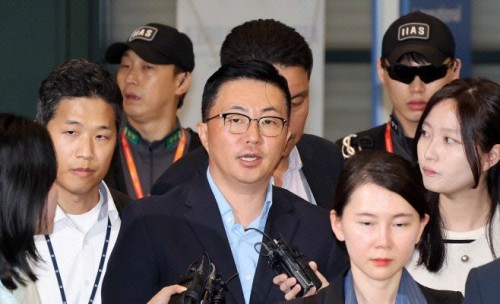 |
| Kim Ye-seong, known as a “steward” to the Kim Kun-hee family, arrives at Incheon International Airport on Aug. 12, 2025. / Song Eui-joo |
A special counsel team investigating allegations linked to Kim Kun-hee suffered another major setback on Sunday, as courts handed down consecutive dismissals and acquittals in high-profile cases, fueling criticism that the probe has failed to meet expectations.
The Seoul Central District Court Criminal Division 26 ruled partly not guilty and partly dismissed the indictment against Kim Ye-seong, described as a “steward” to the Kim family, who had been charged with embezzlement under the Act on the Aggravated Punishment of Specific Economic Crimes.
The court found Kim not guilty of allegations that he conspired with Cho Young-tak, CEO of IMS Mobility, to embezzle 24.3 billion won from InnoBest Korea, a paper company. The judges said the actions could be viewed as efforts to realize the company’s economic interests and could not be conclusively defined as embezzlement due to insufficient evidence.
As for the remaining charges, the court dismissed the indictment, citing procedural flaws. It ruled that the investigation did not stem from any clear link to Kim Kun-hee, was unrelated to the core investment funds under scrutiny, and covered an overly broad time frame—effectively characterizing the probe as an improper “separate-case investigation.” A dismissal of indictment ends a trial without examining the merits due to procedural defects.
On the same day, Criminal Division 21 of the same court sentenced former senior prosecutor Kim Sang-min to six months in prison, suspended for one year, and ordered forfeiture of 41.39 million won for violating anti-graft laws. However, the court acquitted him of allegations that he delivered a high-value painting by artist Lee Ufan to Kim Kun-hee in exchange for help securing a nomination in the April 10, 2024, general election.
The court said it was possible the artwork never reached Kim Kun-hee and remained with her brother, Kim Jin-woo, adding that the special counsel failed to prove its core claim that Kim Sang-min personally purchased and provided the painting to her. The court did find him guilty, however, of receiving illegal donations for campaign-related expenses while preparing to run for office.
Earlier, courts had also dismissed indictments in cases involving a Ministry of Land, Infrastructure and Transport official surnamed Kim and partial charges against Yoon Young-ho, a former executive of the Unification Church. With repeated dismissals and acquittals over the failure to substantiate key allegations, the special counsel has faced mounting criticism for what legal circles describe as excessive or misdirected prosecutions.
The probe has further been dogged by controversy, including accusations of coercive investigations following the death of a public official under questioning, requests to recall all 40 seconded prosecutors, allegations of illegal stock trading involving Special Counsel Min Joong-ki, and claims of biased investigations related to the Unification Church.
Jang Young-soo, emeritus professor at Korea University Law School, said the repeated dismissals raise serious concerns. “The core task is to verify alleged illegal acts by Kim Kun-hee, yet pursuing tangential charges and repeatedly facing dismissals for separate-case investigations is a grave problem,” he said. He added that the upcoming second comprehensive special counsel—combining cases from three prior probes—will have an exceptionally broad scope and must exercise “selection and concentration” in light of recent court rulings.
The special counsel said immediately after the verdicts that both decisions were “difficult to accept in light of the relevant legal principles and evidence,” and announced plans to file appeals.
#Kim Kun-hee special counsel #embezzlement #political favor trading #dismissal of indictment #not guilty verdict
Copyright by Asiatoday
Most Read
-
1
Celltrion’s Omlyclo gains ground in major European..

-
2
Trump demands rates fall below 1% as Fed hikes for..

-
3
Hyundai Motor Group breaks ground on integrated st..

-
4
U.S. strikes 3 Iranian oil tankers, Iran vows reta..

-
5
Trump makes $1 trillion bet ahead of midterm elect..

-
6
Iran resumes ballistic missile production, assembl..

-
7
Samsung Electronics, Mistral AI to jointly develop..

PEOPLE






-
Address : In-Young Bldg., 34, Uisadang-daero 1-gil, Yeongdeungpo-gu, Seoul
Copyright by ASIATODAY CO., LTD. All rights resereved