



Korea to add 3,342 medical students in five years
Feb 11, 2026, 08:11 am


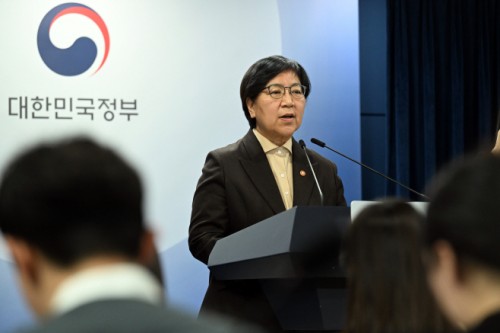 |
| Health and Welfare Minister Jeong Eun-kyeong announces the post-2027 medical workforce training plan at a government briefing in Seoul on Monday. / Photo by Park Sung-il, Asia Today |
The South Korean government has decided to increase medical school enrollment by 3,342 students over the next five years, with all additional slots designated for training regional doctors tasked with serving local, essential and public healthcare systems.
Under the plan, an average of 668 new regional doctors will be selected each year. After graduation, they will be required to work for at least 10 years in designated regions, excluding Seoul, to address long-standing shortages in local and essential medical services.
The Ministry of Health and Welfare approved the plan during the seventh Health and Medical Policy Deliberation Committee meeting held Monday. Medical school quotas will rise from 3,058 in 2024 to 3,548 in 2027, reflecting an increase of 490 students. Enrollment will then expand further to 3,671 in 2028 and 2029 with an additional 613 students each year.
From 2030, the establishment of a public medical school and new regional medical schools — each admitting 100 students annually — is expected to bring the total medical school quota to 3,871. The government aims to secure a stable supply of physicians dedicated to regional, essential and public healthcare over the next decade.
The committee said the expansion plan was based on a physician supply-and-demand forecast through 2037, which projected a shortfall of 4,724 doctors. After accounting for 600 graduates expected from public and newly established regional medical schools, officials concluded that an additional 4,124 physicians must be trained.
All enrollment increases beyond the 2024 quota level will be filled through a special “regional doctor” admissions track. The government capped the 2027 increase at 490 students — about 80 percent of the final target — to prevent strain on medical education, as cohorts from multiple academic years will be trained simultaneously.
For national universities, enrollment increases will be capped at 30 percent of their 2024 quotas, while private universities will face a 20 percent limit. Smaller medical schools with fewer than 50 students will be granted more flexibility to preserve their role in training local medical personnel.
The impact of the expansion on frontline healthcare staffing is expected to emerge after 2033. Between 2033 and 2037, an estimated 3,542 additional doctors — or about 708 per year — are projected to enter the workforce.
Students selected as regional doctors will receive full financial support, including tuition, textbooks, clinical training fees and dormitory or equivalent living expenses. In return, they must serve for 10 years in their assigned regions.
To prepare for the expansion, the government is upgrading lecture halls and clinical training facilities, securing additional faculty members, and establishing clinical education centers at 10 national university hospitals. Residency reforms are also under way, including reducing maximum continuous working hours from 36 to 24 and launching pilot programs to cap weekly training hours.
To bridge the gap before newly trained doctors enter the workforce, the government plans to deploy contract-based regional physicians, utilize senior doctors, expand resident allocations to regional national university hospitals, and strengthen network-based care and cooperative training systems.
Minister Jeong said the expansion was an urgent response to a growing healthcare crisis. “Increasing the number of doctors is no longer something that can be delayed,” she said. “We will work closely with relevant ministries to ensure responsibility from training through long-term settlement in local communities.”
#medical school enrollment #regional doctors #public healthcare #physician shortage #Ministry of Health and Welfare
Copyright by Asiatoday
Most Read
-
1
Trump shares map on social media labeling Strait o..

-
2
Kia Sportage outperforms Mazda CX-5 in German auto..

-
3
Houthis launch successive attacks on Saudi airport..

-
4
U.S. deploys carrier, 10,000 more troops to Middle..

-
5
Trump rejects Iran's offer to open Strait of Hormu..

-
6
N. Korea conducts first swarm attack drill with dr..

-
7
U.S.-China summit falls short on substance as Trum..

PEOPLE





HEADLINE NEWS
- Seoul dismisses Ukraine's claim of 'S. Korean support for Russia' as "inaccurate and inappropriate"
- S. Korea, Japan race to develop nuclear-powered submarines
- Henri Kagan, Kenso Soai win Nobel Prize in Chemistry for uncovering how mol..
- Vance says Alaska LNG cooperation will move forward with Seoul's current or..

-
Address : In-Young Bldg., 34, Uisadang-daero 1-gil, Yeongdeungpo-gu, Seoul
Copyright by ASIATODAY CO., LTD. All rights resereved