



Seoul pushes fast passage of U.S. investment act
Feb 10, 2026, 08:16 am


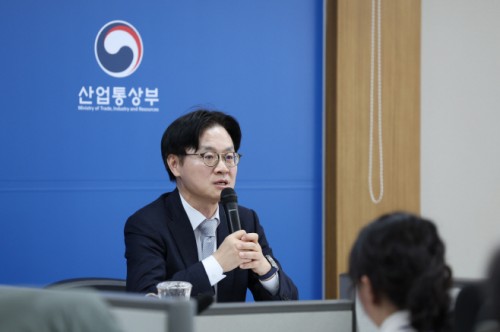 |
| Industry and Trade Minister Kim Jung-kwan speaks to reporters during a background briefing on key industrial policy issues at the government complex in Sejong on Feb. 9. / Ministry of Trade, Industry and Energy |
Industry and Trade Minister Kim Jung-kwan said Sunday the government’s priority is to swiftly pass a special act on U.S.-bound investment, noting that U.S. Commerce Secretary Howard Lutnick has positively assessed the bipartisan agreement in Seoul.
Speaking at a background briefing at the government complex in Sejong, Kim said he is focused on preventing a potential reimposition of 25 percent U.S. tariffs on South Korean products rather than merely delaying their publication in the Federal Register. “The essence of the issue is the delay in legislation,” he said. “Passing the special act quickly is the top priority.”
Kim explained that since President Donald Trump mentioned the possibility of tariff hikes on social media, the usual three-to-seven-day process for Federal Register publication has been delayed for nearly two weeks. “That indicates our efforts are being conveyed to the U.S. side,” he said.
On negotiations with Washington, Kim said he met twice last week with Secretary Lutnick and that talks are “making incremental progress.” He added that the government has clearly conveyed its position that prompt passage of the investment special act is essential.
Kim said Seoul has shared with Washington the ruling and opposition parties’ agreement to pass the bill by early March, an approach he said Lutnick “highly evaluated.” Lawmakers agreed on Feb. 4 to form a special committee to handle the bill, and a resolution establishing the panel passed the National Assembly the same day. The committee will operate for one month through March 9.
Asked whether passage of the bill could lead Washington to withdraw plans for tariff hikes, Kim said that because President Trump cited the legislation as a reason for considering higher tariffs, resolving the issue could make a suspension of the increase “highly likely.”
He stressed that Seoul has also explained to the U.S. that, unlike Japan, South Korea requires a separate legislative process to advance large-scale U.S. investments. At the same time, Kim rejected claims that Washington is linking delayed investment to non-tariff barriers, saying the core issue remains the legislative delay.
Addressing controversy surrounding Coupang, Kim said it should not be directly tied to tariff talks. “The essence of the Coupang issue is personal data protection,” he said, noting that the United States is also strict on privacy. He added that U.S. officials appeared to understand the point after he explained how Washington might respond if a company transferred personal data covering roughly 80 percent of its adult population overseas.
#Kim Jung-kwan #Howard Lutnick #U.S. tariffs #investment special act #Ministry of Trade Industry and Energy
Copyright by Asiatoday
Most Read
-
1
Trump shares map on social media labeling Strait o..

-
2
Kia Sportage outperforms Mazda CX-5 in German auto..

-
3
Houthis launch successive attacks on Saudi airport..

-
4
U.S. deploys carrier, 10,000 more troops to Middle..

-
5
Trump rejects Iran's offer to open Strait of Hormu..

-
6
N. Korea conducts first swarm attack drill with dr..

-
7
U.S.-China summit falls short on substance as Trum..

PEOPLE






HEADLINE NEWS
- Seoul dismisses Ukraine's claim of 'S. Korean support for Russia' as "inaccurate and inappropriate"
- S. Korea, Japan race to develop nuclear-powered submarines
- Henri Kagan, Kenso Soai win Nobel Prize in Chemistry for uncovering how mol..
- Vance says Alaska LNG cooperation will move forward with Seoul's current or..

-
Address : In-Young Bldg., 34, Uisadang-daero 1-gil, Yeongdeungpo-gu, Seoul
Copyright by ASIATODAY CO., LTD. All rights resereved