



Why Lee’s nonstop social media politics continues
Feb 10, 2026, 08:16 am


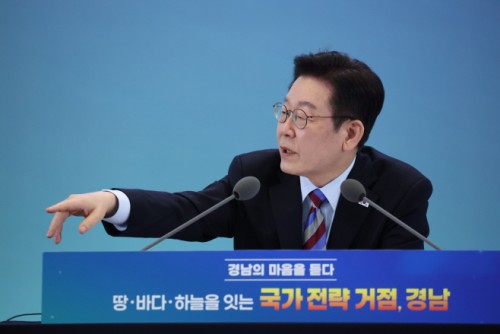 |
| President Lee Jae-myung speaks during a town hall meeting titled “Listening to Gyeongnam’s Voices” at the Changwon Convention Center in Seongsan-gu, Changwon, on Feb. 6. / Yonhap |
President Lee Jae-myung’s increasingly frequent use of social media is set to continue, according to aides, who say the strategy goes beyond communication and is designed to pressure both the ruling party and the bureaucracy to move faster on policy execution.
From sharp political messages to personal posts about his spouse, Lee has long been known for active engagement on social platforms. Recently, however, people close to the president say the intent is more calculated: to amplify policy momentum, set reform agendas, and send a clear signal to lawmakers and civil servants alike to “work harder.”
Political circles say Prime Minister Kim Min-seok and presidential chief of staff Kang Hoon-sik publicly criticized the National Assembly’s slow legislative pace at a high-level party-government meeting on Sunday. While Democratic Party leader Jung Cheong-rae stressed a “one-team” approach among the party, government, and presidential office, senior officials voiced concern that even core policy bills are failing to advance in time.
Lee himself has expressed open frustration. At a Cabinet meeting on Jan. 27, he said that nearly eight months into his administration, only about 20 percent of legislation underpinning key policy directions had passed. “The National Assembly is moving so slowly that it’s hard to get anything done,” he said.
The president’s remarks followed a comment by the National Tax Service chief suggesting he would wait for legislation before securing manpower to collect overdue revenues—prompting a sharp rebuke from Lee.
Of 23 bills needed to implement the government’s Sept. 7 housing supply plan—aimed at providing 270,000 homes annually in the greater Seoul area starting this year—only four have passed the Assembly. Similarly, measures announced nearly six months ago to reduce industrial accidents and curb wage arrears have seen just three of 16 related bills approved.
Given that Lee has repeatedly emphasized building “a country where people do not die at work,” aides say the legislative delays are particularly painful for the administration.
Despite holding enough seats to pass bills unilaterally, the ruling Democratic Party of Korea has yet to expedite many of the Lee administration’s flagship measures. Recent controversies—ranging from a surprise merger proposal with another party to disputes over nominations for a second comprehensive special counsel—have further fueled internal noise.
A presidential office official said Lee often remarks that he has “only four years and nine months left,” adding that the president appears to be intensifying and increasing the frequency of his messages because the ruling party is not fully aligned with his urgency.
Civil service inertia is also in Lee’s sights, aides say. When the president outlines a policy direction on social media and asks, “What do you think?” it is effectively an instruction to review and act. Another senior official recalled that early in the administration, some ministries were slow to respond to directives, partly due to lingering fears of investigations after past political turnovers.
“Things have improved,” the official said, “but the president’s message is clear: this is a signal that the pace needs to pick up—and it will keep coming.”
#Lee Jae-myung #presidential social media #policy pressure #legislative delay #Democratic Party
Copyright by Asiatoday
Most Read
-
1
Trump shares map on social media labeling Strait o..

-
2
Kia Sportage outperforms Mazda CX-5 in German auto..

-
3
Houthis launch successive attacks on Saudi airport..

-
4
U.S. deploys carrier, 10,000 more troops to Middle..

-
5
Trump rejects Iran's offer to open Strait of Hormu..

-
6
N. Korea conducts first swarm attack drill with dr..

-
7
U.S.-China summit falls short on substance as Trum..

PEOPLE





HEADLINE NEWS
- Seoul dismisses Ukraine's claim of 'S. Korean support for Russia' as "inaccurate and inappropriate"
- S. Korea, Japan race to develop nuclear-powered submarines
- Henri Kagan, Kenso Soai win Nobel Prize in Chemistry for uncovering how mol..
- Vance says Alaska LNG cooperation will move forward with Seoul's current or..

-
Address : In-Young Bldg., 34, Uisadang-daero 1-gil, Yeongdeungpo-gu, Seoul
Copyright by ASIATODAY CO., LTD. All rights resereved