



Yoon’s 443-day political crisis ends in life term
Feb 20, 2026, 03:46 pm


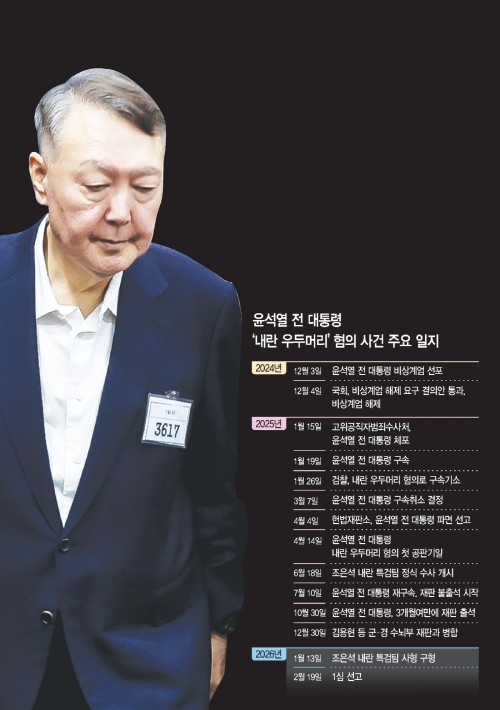 |
South Korea’s political landscape was thrown into unprecedented turmoil for 443 days — from the declaration of martial law to impeachment, removal from office and a final court verdict against former President Yoon Suk Yeol.
At 10:25 p.m. on Dec. 3, 2024, Yoon declared emergency martial law in a televised national address, saying, “I hereby declare martial law in order to safeguard the Republic of Korea from the threat of North Korean communist forces, eradicate shameless pro-North anti-state elements plundering the freedom and happiness of our people, and protect the constitutional order of freedom.”
It marked the first declaration of martial law in 45 years, since Oct. 26, 1979. Political parties immediately convened emergency meetings, and several lawmakers — including National Assembly Speaker Woo Won-shik — scaled the National Assembly walls to attend a plenary session.
At 1:01 a.m. on Dec. 4, all 190 lawmakers present voted in favor of a resolution demanding the lifting of martial law. Roughly three hours after the declaration, Yoon accepted the Assembly’s request at 4:27 a.m.
On Dec. 8, Yoon was booked as a suspect on charges of insurrection, and a travel ban was imposed the following day. Prosecutors, police and the Corruption Investigation Office for High-ranking Officials launched simultaneous investigations — the first time in constitutional history that a sitting president faced such parallel probes.
Amid concerns over overlapping investigations, the CIO exercised its transfer authority and took charge of the case on Dec. 18. Yoon refused three summonses for questioning. On Dec. 30, the CIO requested an arrest warrant from the Seoul Western District Court, which was issued the next day.
An initial attempt to execute the warrant on Jan. 3, 2025, failed after a standoff with the Presidential Security Service at the presidential residence in Hannam-dong. Police deployed some 2,700 officers to prevent clashes with supporters.
A second warrant was reissued on Jan. 7. On Jan. 15 at 10:30 a.m., investigators executed the warrant and arrested Yoon at his residence — 12 days after the first failed attempt. After more than eight hours of questioning, he was transferred to the Seoul Detention Center.
The prosecution’s special investigation team later indicted Yoon on Jan. 26 on charges of leading an insurrection. However, on March 7, a court canceled his detention, ruling that he had been indicted after the legal detention period had expired. Yoon was released after 52 days in custody, and his trial proceeded without detention beginning April 14.
Meanwhile, the National Assembly passed an impeachment motion, triggering a trial at the Constitutional Court of Korea. After 11 hearings, all eight justices unanimously ruled on April 4 to remove Yoon from office, marking the second presidential removal in South Korean history after former President Park Geun-hye.
A new phase of the insurrection investigation began with the launch of a special counsel team led by Cho Eun-seok. After six months of investigation, the special counsel sought the death penalty for Yoon.
On Feb. 19, the court sentenced Yoon to life imprisonment on charges of leading an insurrection — the first judicial ruling related to the Dec. 3 martial law declaration, delivered 443 days after the crisis began.
The verdict marked a dramatic conclusion to one of the most turbulent political chapters in South Korea’s modern history.
#Yoon Suk Yeol #martial law #impeachment #Constitutional Court #insurrection charges
Copyright by Asiatoday
Most Read
-
1
Celltrion’s Omlyclo gains ground in major European..

-
2
Trump demands rates fall below 1% as Fed hikes for..

-
3
Hyundai Motor Group breaks ground on integrated st..

-
4
U.S. strikes 3 Iranian oil tankers, Iran vows reta..

-
5
Trump makes $1 trillion bet ahead of midterm elect..

-
6
Iran resumes ballistic missile production, assembl..

-
7
Samsung Electronics, Mistral AI to jointly develop..

PEOPLE






-
Address : In-Young Bldg., 34, Uisadang-daero 1-gil, Yeongdeungpo-gu, Seoul
Copyright by ASIATODAY CO., LTD. All rights resereved