



Korea retail sales rebound in 2025 amid high prices
Feb 20, 2026, 05:43 pm


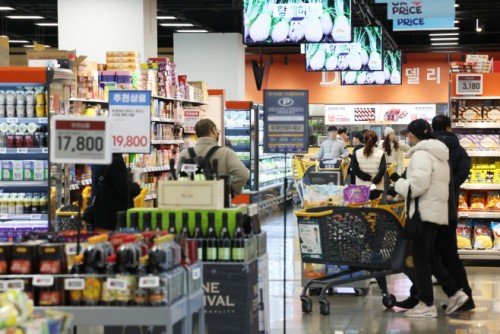 |
| Shoppers browse groceries at a large supermarket in Seoul’s Gangdong District on Jan. 18. / Yonhap |
South Korea’s retail sales increased last year despite inflation hovering in the 2 percent range, marking the first annual gain in four years, government data showed Thursday.
According to the “Annual Regional Economic Trends” report released by Statistics Korea, nationwide retail sales — a key gauge of private consumption — rose 0.5 percent from a year earlier.
Retail sales reflect the total volume of goods and services sold to individual consumers at outlets such as supermarkets, department stores and convenience stores, and are widely regarded as an indicator of consumer sentiment and domestic demand.
By region, retail sales declined in three areas — Jeju (-3.1 percent), Seoul (-2.7 percent) and North Gyeongsang Province (-0.7 percent). The remaining 14 provinces and metropolitan cities posted gains.
Incheon and Sejong led the increase, recording growth rates of 4.5 percent and 4.1 percent, respectively. In Incheon, duty-free shop sales surged 29.7 percent year-on-year in the fourth quarter, benefiting from year-end travel demand.
Spending at passenger car and fuel retail outlets rose 5.3 percent from a year earlier, while non-store retail and specialty stores increased 1.5 percent and 1 percent, respectively.
By contrast, duty-free sales fell 20.2 percent in Seoul and 13.3 percent in Jeju. Supermarkets, general merchandise stores and convenience stores in those regions also posted declines of 6.7 percent and 4 percent.
The turnaround came even as consumer prices rose 2.1 percent year-on-year, excluding dining-out services.
Economists attribute the rebound largely to temporary factors, including government-issued consumption coupons aimed at boosting domestic demand in the second half of the year, as well as gains in the stock market.
During the months when the “livelihood recovery” coupons were distributed, the retail sales index posted sharp month-on-month increases. In July, when the first round of coupons was issued, the index rose 2.5 percent — the largest increase in 29 months. After the second round in October, the index jumped 3.5 percent.
Some experts cautioned that last year’s growth may not be sustained without addressing structural challenges.
Kim Jung-sik, emeritus professor of economics at Yonsei University, said the rebound was driven by temporary factors such as consumption coupons and stock market gains.
“With a high exchange rate and a prolonged slump in the construction sector expected this year, domestic demand could weaken again,” he said.
To maintain the recovery, Kim suggested stabilizing real estate prices to revive construction activity, curbing inflation through exchange rate stability, and reducing policy uncertainty to bolster overall economic confidence.
Despite ongoing trade uncertainties, including reciprocal tariffs imposed by the United States, exports rose 3.6 percent from a year earlier.
Memory semiconductors, riding an industry upcycle, surged 34.8 percent year-on-year and led overall export growth. Regionally, exports jumped 80.2 percent in Jeju and 26.8 percent in North Chungcheong Province.
The data suggest that while consumer spending showed modest improvement, sustaining momentum will depend on stabilizing broader economic conditions at home and abroad.
#retail sales #consumer spending #inflation
Copyright by Asiatoday
Most Read
-
1
Celltrion’s Omlyclo gains ground in major European..

-
2
Trump demands rates fall below 1% as Fed hikes for..

-
3
Trump makes $1 trillion bet ahead of midterm elect..

-
4
Iran resumes ballistic missile production, assembl..

-
5
Trump warns countries not helping U.S. must pay re..

-
6
Apple launches first foldable, 1 million won prici..

-
7
Turkish Airlines named main club partner of Liverp..

PEOPLE






-
Address : In-Young Bldg., 34, Uisadang-daero 1-gil, Yeongdeungpo-gu, Seoul
Copyright by ASIATODAY CO., LTD. All rights resereved