



‘Day of reckoning’ for Yoon as court rules on insurrection
Feb 19, 2026, 09:06 am


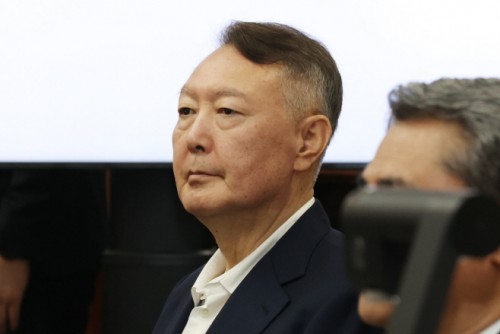 |
| Former President Yoon Suk Yeol attends his first trial following indictment by the special counsel. /Joint Press Corps |
A first judicial ruling on the alleged insurrection led by former President Yoon Suk Yeol will be delivered on Feb. 19, 443 days after the declaration of martial law that triggered a political crisis.
The Seoul Central District Court’s Criminal Division 25, presided over by Chief Judge Ji Gui-yeon, is scheduled to hand down the first-instance verdict at 3 p.m. in Courtroom 417. The hearing will be broadcast live, and Yoon is expected to appear in person.
Yoon has been charged as the ringleader of an alleged insurrection linked to the Dec. 3 martial law declaration. Under Korean law, the statutory penalties for leading an insurrection are limited to death, life imprisonment, or life imprisonment without forced labor.
The special counsel team, led by Cho Eun-seok, demanded the maximum penalty of death during the final hearing last month. The prosecution defined the Dec. 3 martial law declaration as a “grave constitutional destruction incident by anti-state forces,” arguing that strict punishment harsher than that imposed on past military strongmen was necessary to prevent a tragic recurrence of history.
The special counsel contended that behind the emergency decree — the first declared in 45 years — lay an ambition for authoritarian rule and prolonged grip on power.
Key legal issues
To establish the crime of insurrection, prosecutors must prove two elements: intent to subvert the constitutional order and the occurrence of a riot.
The court’s key considerations include whether Yoon intended to paralyze constitutional institutions such as the National Assembly and the National Election Commission through the martial law declaration, and whether the deployment of troops to the Assembly constituted violence or intimidation sufficient to disrupt public peace in a given area.
Earlier rulings have already concluded that the Dec. 3 martial law declaration amounted to insurrection.
In the first trial of former Prime Minister Han Duck-soo, the Seoul Central District Court’s Criminal Division 33 recognized both intent to subvert the constitutional order and the existence of a riot. The court ruled that the declaration of martial law and the issuance of decrees were aimed at nullifying constitutional and legal functions, and that mobilizing military and police forces to occupy and control access to the National Assembly and the election commission constituted a riot disturbing public peace.
A similar conclusion was reached in the first trial of former Interior Minister Lee Sang-min. The court grouped Yoon and former Defense Minister Kim Yong-hyun as part of an “insurrection group,” recognizing the overall planning and execution of martial law as unconstitutional and illegal acts of insurrection.
Notably, the court in Han’s case described the episode as an “insurrection from above,” indicating that it originated from the highest authority — then-President Yoon.
Legal experts widely expect that if lower-ranking officials were found guilty, a heavier sentence for the alleged leader would be unavoidable.
A former presiding judge-turned-lawyer, speaking on condition of anonymity, said, “Court rulings inevitably serve as precedents. Since previous judgments have already defined the Dec. 3 martial law as insurrection, it would not be easy to overturn that conclusion.”
He added that the crucial issue is whether the court recognizes Yoon as the architect and executor — the ‘ringleader’ — of the martial law declaration. “There is no authority above the president in the Republic of Korea. The president who approved and proclaimed martial law inevitably stands at the top. It is virtually impossible to shift that responsibility to others,” he said.
However, the lawyer noted that while the statutory penalty is death or life imprisonment, sentencing could still be reduced if mitigating factors are recognized. “Even former President Chun Doo-hwan, who was responsible for numerous casualties, ultimately had his sentence commuted to life imprisonment. While a guilty verdict for Yoon appears likely, the actual sentence will depend on the scale of damage and overall consequences,” he said.
#Yoon Suk Yeol #insurrection charges #martial law #Seoul Central District Court
Copyright by Asiatoday
Most Read
-
1
Celltrion’s Omlyclo gains ground in major European..

-
2
Trump demands rates fall below 1% as Fed hikes for..

-
3
Hyundai Motor Group breaks ground on integrated st..

-
4
U.S. strikes 3 Iranian oil tankers, Iran vows reta..

-
5
Trump makes $1 trillion bet ahead of midterm elect..

-
6
Iran resumes ballistic missile production, assembl..

-
7
Samsung Electronics, Mistral AI to jointly develop..

PEOPLE







-
Address : In-Young Bldg., 34, Uisadang-daero 1-gil, Yeongdeungpo-gu, Seoul
Copyright by ASIATODAY CO., LTD. All rights resereved