



Bithumb overpayment sparks calls for tougher oversight
Feb 12, 2026, 08:17 am


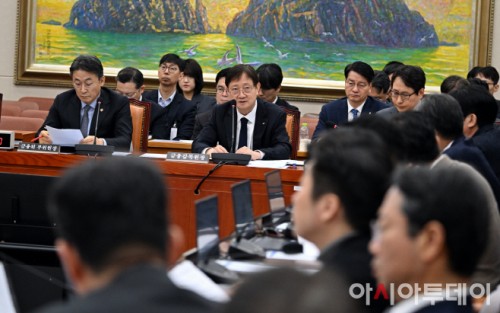 |
| Lee Chan-jin, governor of the Financial Supervisory Service (center), answers lawmakers’ questions during an emergency parliamentary inquiry on the Bithumb incident at the National Assembly on Feb. 11. / Photo by Song Eui-ju |
South Korean lawmakers expressed shock Tuesday after it was revealed that cryptocurrency exchange Bithumb’s 60 trillion won ($45 billion) bitcoin overpayment incident could, in theory, have resulted in unlimited payouts or even external asset leakage due to faulty internal controls.
During an emergency inquiry session of the National Assembly’s Political Affairs Committee on Feb. 11, Bithumb CEO Lee Jae-won admitted that the exchange’s cross-verification system — designed to match scheduled payouts with actual holdings — had failed to operate properly.
“The system that cross-checks the amount scheduled for payment against the actual holdings did not function this time,” Lee said, bowing in apology. “We sincerely apologize for causing concern to the public.”
Lawmakers from both ruling and opposition parties criticized what they described as structural risks rather than a simple mistake. Rep. Park Sang-hyuk of the Democratic Party said, “No control mechanism functioned. In theory, bitcoins could have been generated and paid out infinitely or leaked externally without being blocked.”
Rep. Kang Min-kook of the People Power Party warned that public trust in the crypto market had plummeted, noting that related search terms now include “Cambodian crime proceeds” and “hacking.” Rep. Lee Kang-il of the Democratic Party added that trust had already eroded amid allegations of improper listing solicitations.
Rep. Heo Young criticized the exchange for spending 50 to 60 billion won on marketing while failing to implement an overpayment prevention system that could reportedly have been built for around 100 million won. Rep. Yoo Young-ha of the People Power Party said that without stricter oversight, “large-scale accidents will recur, authorities will scramble to intervene, and companies will simply apologize and move on,” stressing that tougher external regulation is inevitable.
In response to the incident, KB Kookmin Bank — Bithumb’s partner for real-name accounts — issued urgent alerts to customers amid a surge in phishing scams impersonating the exchange and investigative authorities. Reports indicate the bank has begun reviewing the terms of its partnership agreement.
Bithumb has also faced allegations that it pressured employees to consent to changes in employment rules, including the introduction of a wage peak system, even as it was handling the fallout from the incident.
Kwon Dae-young, vice chairman of the Financial Services Commission, acknowledged the limits of self-regulation. “The shortcomings of voluntary regulation have been clearly exposed,” he said. “We will expedite second-stage legislation, including mandatory internal controls equivalent to those required of financial institutions and the introduction of strict liability for damages.”
The episode has also cast doubt on plans to allow cryptocurrency exchanges to open corporate accounts. An industry official noted that exchanges previously halted corporate accounts due to concerns that they were being used for voice phishing withdrawals or illegal gambling funds.
“Even the industry leader Upbit recently suffered a hacking incident involving hundreds of billions of won worth of Solana-based coins,” the official said. “Whether due to human error or system failure, basic deposit and withdrawal controls are not fully secured. Opening the corporate market prematurely could trigger severe repercussions.”
The Bithumb incident has intensified calls for stronger regulatory frameworks as South Korea’s crypto sector grapples with mounting scrutiny over security and governance standards.
#Bithumb #bitcoin overpayment #National Assembly #Financial Supervisory Service
Copyright by Asiatoday
Most Read
-
1
Trump shares map on social media labeling Strait o..

-
2
Kia Sportage outperforms Mazda CX-5 in German auto..

-
3
Houthis launch successive attacks on Saudi airport..

-
4
U.S. deploys carrier, 10,000 more troops to Middle..

-
5
Trump rejects Iran's offer to open Strait of Hormu..

-
6
N. Korea conducts first swarm attack drill with dr..

-
7
U.S.-China summit falls short on substance as Trum..

PEOPLE





HEADLINE NEWS
- Seoul dismisses Ukraine's claim of 'S. Korean support for Russia' as "inaccurate and inappropriate"
- S. Korea, Japan race to develop nuclear-powered submarines
- Henri Kagan, Kenso Soai win Nobel Prize in Chemistry for uncovering how mol..
- Vance says Alaska LNG cooperation will move forward with Seoul's current or..

-
Address : In-Young Bldg., 34, Uisadang-daero 1-gil, Yeongdeungpo-gu, Seoul
Copyright by ASIATODAY CO., LTD. All rights resereved