



Ruling party calms merger clash, faces new interference claims
Feb 12, 2026, 08:17 am


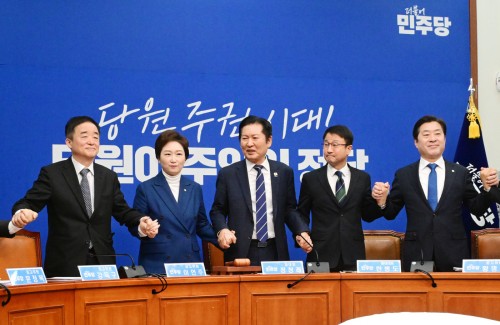 |
| Jung Cheong-rae, leader of the Democratic Party of Korea (center), floor leader Han Byung-do (second from right), and Supreme Council members hold hands ahead of a council meeting at the National Assembly on Feb. 11. / Photo by Lee Byung-hwa |
The Democratic Party of Korea (DPK) has temporarily quelled internal conflict over a proposed pre–June 3 local election merger with the Rebuilding Korea Party, but a fresh controversy over alleged presidential interference in party affairs has resurfaced.
According to political sources on Feb. 11, the failed merger attempt dealt a blow to the leadership of both parties. DPK leader Jung Cheong-rae faced strong internal backlash for allegedly pushing the merger without sufficient consultation with the party’s leadership.
As infighting intensified, Jung appeared increasingly isolated among lawmakers, exposing questions about whether he has fully consolidated control over the party. Cho Kuk, leader of the Rebuilding Korea Party, also now faces the challenge of proving his party’s competitiveness independently in the upcoming local elections after the merger talks collapsed.
Jung had justified the merger drive as a strategy for “winning the local elections” and ensuring the success of the Lee Jae-myung administration. However, non-mainstream factions within the DPK questioned whether Jung was seeking to expand his support base ahead of the August party convention by absorbing Rebuilding Korea Party members.
Even if merger discussions resume after the local elections, further internal resistance remains a possibility.
The Rebuilding Korea Party’s stance has also grown more complicated. Spokesperson Park Byung-eon said, “Merger discussions have been halted,” but added that nothing has been decided regarding whether talks could resume after the elections.
For the Rebuilding Korea Party, electoral success in June is seen as key to ensuring that any future integration would be conducted as a party-to-party merger rather than an absorption. Park described the merger as “a double-edged sword,” noting that the party was founded on a strategy of “regional votes for the Democratic Party, proportional votes for the Innovation Party.”
Meanwhile, some analysts suggest Prime Minister Kim Min-seok could benefit politically from the turmoil, as clearer factional lines within the DPK may encourage pro-Lee Jae-myung lawmakers to rally around him. A group of around 70 DPK lawmakers has reportedly expressed intent to participate in efforts to seek the cancellation of charges against President Lee and pursue a parliamentary investigation.
The controversy flared anew when Supreme Council member Kang Deuk-gu posted — and quickly deleted — a social media message suggesting that a post-election merger reflected President Lee’s wishes. Kang later said the post did not align with the facts and attributed it to an internal mistake within his office, apologizing for any misunderstanding.
The People Power Party seized on the incident. Spokesperson Park Min-young criticized what she described as presidential interference in party affairs, arguing that such actions mirror grounds previously cited by the DPK during the impeachment of former President Park Geun-hye. She claimed the episode constituted “strong evidence” that pro-Lee Supreme Council members had been pressuring party leadership under direction from the presidential office.
While the immediate merger dispute appears to have subsided, the renewed debate over presidential involvement in party matters suggests internal tensions within the ruling camp are far from resolved.
#Democratic Party of Korea #Rebuilding Korea Party #Jung Cheong-rae #Lee Jae-myung #Kim Min-seok
Copyright by Asiatoday
Most Read
-
1
Trump shares map on social media labeling Strait o..

-
2
Kia Sportage outperforms Mazda CX-5 in German auto..

-
3
Houthis launch successive attacks on Saudi airport..

-
4
U.S. deploys carrier, 10,000 more troops to Middle..

-
5
Trump rejects Iran's offer to open Strait of Hormu..

-
6
N. Korea conducts first swarm attack drill with dr..

-
7
U.S.-China summit falls short on substance as Trum..

PEOPLE





HEADLINE NEWS
- Seoul dismisses Ukraine's claim of 'S. Korean support for Russia' as "inaccurate and inappropriate"
- S. Korea, Japan race to develop nuclear-powered submarines
- Henri Kagan, Kenso Soai win Nobel Prize in Chemistry for uncovering how mol..
- Vance says Alaska LNG cooperation will move forward with Seoul's current or..

-
Address : In-Young Bldg., 34, Uisadang-daero 1-gil, Yeongdeungpo-gu, Seoul
Copyright by ASIATODAY CO., LTD. All rights resereved