



PM sets February deadline for regional merger
Feb 12, 2026, 08:17 am


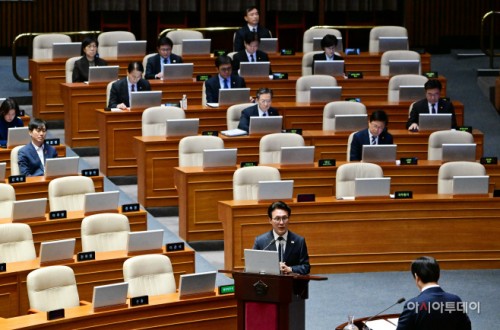 |
| Prime Minister Kim Min-seok answers a question from Rep. Hwang Myung-sun of the Democratic Party during a parliamentary interpellation session on education, social and cultural affairs at the National Assembly on Feb. 11. / Photo by Lee Byung-hwa |
Prime Minister Kim Min-seok said Wednesday that regional administrative integration would be “virtually impossible” before the June local elections unless the relevant special law is passed by the end of February, setting a clear deadline for legislative action.
Speaking at a parliamentary interpellation session on education, social and cultural affairs at the National Assembly on Feb. 11, Kim responded to a question from Rep. Hwang Myung-sun of the Democratic Party regarding the “golden time” for administrative integration.
“Realistically, if the special law does not pass the plenary session by the end of February, integration before the election will be nearly impossible,” Kim said, citing the administrative measures and election preparations required after the bill’s passage.
Currently, special bills for administrative integration in three regions — Daejeon–South Chungcheong, Gwangju–South Jeolla and Daegu–North Gyeongsang — are pending in the National Assembly.
Kim also expressed concern over delays in discussions on the Daejeon–South Chungcheong merger. “The Daejeon–South Chungcheong integration, first proposed by local government heads from the People Power Party, is facing the most delays due to internal disagreements,” he said. “Meanwhile, Gwangju–South Jeolla and Daegu–North Gyeongsang are gaining speed.”
“In some cases, Daejeon–South Chungcheong alone may fail to reach the finish line among the three integration zones,” Kim added. “Any resulting disadvantages would be borne entirely by local residents.”
The government also reaffirmed significant incentives for integrated local governments. Interior and Safety Minister Yoon Ho-jung pledged financial support totaling 20 trillion won — 5 trillion won annually over four years — and priority consideration for relocation sites in the second phase of public institution transfers. The measures are seen as incentives aligned with the administration’s core strategy of establishing a “5 mega-regions, 3 special self-governing provinces” system.
During the session, opposition lawmakers from the People Power Party continued to criticize the administration’s real estate policies. Rep. Yoon Jae-ok took issue with President Lee Jae-myung’s recent social media remarks criticizing multiple homeowners, claiming the government was attempting to “push through with state power like a crackdown on illegal valley businesses.”
Yoon also raised concerns over the proposed Real Estate Supervisory Agency, arguing it could treat citizens as potential criminals through excessive authority, such as reviewing bank accounts without warrants.
Kim pushed back, saying, “The Real Estate Supervisory Agency is not an oppressive institution that fabricates crimes. Its purpose is to investigate unfair transactions and normalize the market, and investigative authority will be granted under strict conditions.”
The session also saw debate over the implementation of the so-called Yellow Envelope Act. Labor Minister Kim Young-hoon rejected business groups’ calls to delay enforcement, stating that the law would take effect as scheduled on March 10.
“Indefinite postponement is not the solution,” he said. “As we implement the law, we will minimize confusion in the field and work to establish a model of coexistence between labor and management.”
#Kim Min-seok #administrative integration #special law #local elections
Copyright by Asiatoday
Most Read
-
1
Trump shares map on social media labeling Strait o..

-
2
Kia Sportage outperforms Mazda CX-5 in German auto..

-
3
Houthis launch successive attacks on Saudi airport..

-
4
U.S. deploys carrier, 10,000 more troops to Middle..

-
5
Trump rejects Iran's offer to open Strait of Hormu..

-
6
N. Korea conducts first swarm attack drill with dr..

-
7
U.S.-China summit falls short on substance as Trum..

PEOPLE






HEADLINE NEWS
- Seoul dismisses Ukraine's claim of 'S. Korean support for Russia' as "inaccurate and inappropriate"
- S. Korea, Japan race to develop nuclear-powered submarines
- Henri Kagan, Kenso Soai win Nobel Prize in Chemistry for uncovering how mol..
- Vance says Alaska LNG cooperation will move forward with Seoul's current or..

-
Address : In-Young Bldg., 34, Uisadang-daero 1-gil, Yeongdeungpo-gu, Seoul
Copyright by ASIATODAY CO., LTD. All rights resereved