



Jung vows to push judicial reform on schedule
Feb 12, 2026, 08:16 am


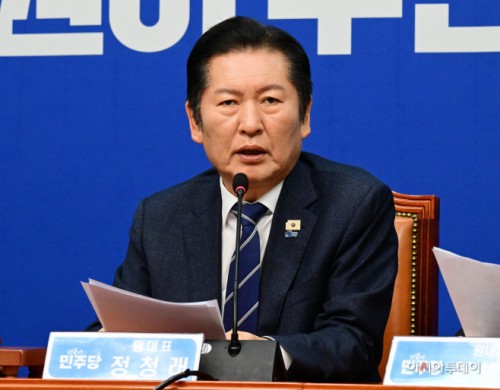 |
| Jung Cheong-rae, leader of the Democratic Party of Korea, delivers opening remarks at the party’s Supreme Council meeting at the National Assembly on Feb. 11. / Photo by Lee Byung-hwa |
Legislative momentum, once stalled by constitutional concerns and the possibility of a filibuster, may regain speed.
Jung Cheong-rae, leader of the Democratic Party of Korea, said he would push ahead with judicial and prosecution reform legislation — including the proposed “distortion of law” offense under a revision to the Criminal Act — according to the original timetable without delay.
Speaking at a Supreme Council meeting at the National Assembly on Feb. 11, Jung said, “We will process the distortion of law offense bill, the Constitutional Court Act revision (constitutional complaint law), and the Court Organization Act revision (Supreme Court justice expansion bill) on schedule, without disruption and without compromise.” He added, “We will also pass the Prosecution Office and Serious Crimes Investigation Office bills on schedule.”
He continued, “The party has already determined its position regarding the review of the supplementary investigation request authority. The government has also decided to address the matter through the Criminal Procedure Act,” noting that the related bills would be handled with a time gap, unlike the Prosecution Office and Serious Crimes Investigation Office legislation. “As these are government-initiated bills, we ask that the government fully consider the party’s position when drafting the proposal,” he said.
The Democratic Party had initially planned to pass the judicial reform bills within this month. However, concerns over possible unconstitutionality and the opposition’s potential filibuster led to speculation that livelihood-related bills would be prioritized. Jung’s reaffirmation of his commitment to stick to the timetable is expected to accelerate the legislative process.
When asked whether the relevant bills would be processed at the Legislation and Judiciary Committee meeting that day, Senior Spokesperson Park Soo-hyun responded, “Yes.” He explained that after livelihood bills are handled at the plenary session on Feb. 12, the party would prepare the necessary procedures to pass the reform bills at a plenary session during the February extraordinary session.
On the same day, the committee is set to review the constitutional complaint law at a subcommittee meeting and examine the Supreme Court justice expansion bill at a full committee meeting. The distortion of law offense bill was approved by the full committee in December and has been referred to the plenary session. The bills establishing the Prosecution Office and the Serious Crimes Investigation Office are expected to be reviewed by the committee once the government submits revised proposals and could be passed at a plenary session as early as March.
#Jung Cheong-rae #Democratic Party of Korea #judicial reform #prosecution reform #distortion of law offense
Copyright by Asiatoday
Most Read
-
1
Trump shares map on social media labeling Strait o..

-
2
Kia Sportage outperforms Mazda CX-5 in German auto..

-
3
Houthis launch successive attacks on Saudi airport..

-
4
U.S. deploys carrier, 10,000 more troops to Middle..

-
5
Trump rejects Iran's offer to open Strait of Hormu..

-
6
N. Korea conducts first swarm attack drill with dr..

-
7
U.S.-China summit falls short on substance as Trum..

PEOPLE






HEADLINE NEWS
- Seoul dismisses Ukraine's claim of 'S. Korean support for Russia' as "inaccurate and inappropriate"
- S. Korea, Japan race to develop nuclear-powered submarines
- Henri Kagan, Kenso Soai win Nobel Prize in Chemistry for uncovering how mol..
- Vance says Alaska LNG cooperation will move forward with Seoul's current or..

-
Address : In-Young Bldg., 34, Uisadang-daero 1-gil, Yeongdeungpo-gu, Seoul
Copyright by ASIATODAY CO., LTD. All rights resereved