



Ruling party touts recovery, opposition slams housing policy
Feb 11, 2026, 08:11 am


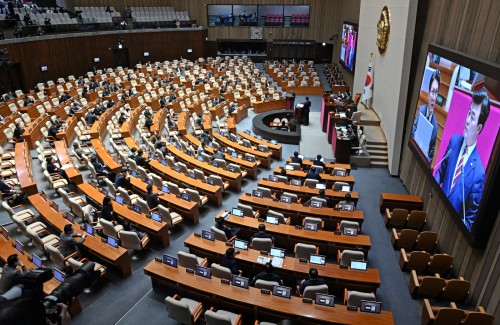 |
| Prime Minister Kim Min-seok answers a question from Rep. Yoon Young-seok during an economic policy interpellation session at the National Assembly on Monday. / Photo by Song Eui-joo |
o promote its economic record, emphasizing the rise of the benchmark stock index. Rep. Park Sang-hyuk cited improvements in exports and foreign exchange reserves, arguing that “the economy is recovering compared to the previous administration, when people’s livelihoods were shattered by the turmoil of an attempted insurrection.”
Proposals for advancing capital market reform were also raised. Rep. Kim Tae-nyeon called for redefining the KOSDAQ market as an independent innovation market rather than a secondary tier of KOSPI, suggesting a structural separation.
Prime Minister Kim responded that the president has also stressed the need to pay closer attention to KOSDAQ amid gains in the main market, pledging to work with the National Assembly on legislative measures.
The People Power Party, however, kept up its offensive by highlighting high inflation and a weak currency. Rep. Lee In-seon said the exchange rate hovering around 1,400 won per dollar has become the norm under the current administration, calling it a “three-strike government” that is undermining households, businesses and the future through loose fiscal management.
Lawmakers also sparred over responsibility for mounting tariff pressure from the Trump administration in the United States. Rep. Yoon Young-seok claimed that distrust toward the Korean government in Washington has fueled threats of a 25 percent tariff hike.
Prime Minister Kim rejected the accusation, saying the pressure reflects unilateral action by the U.S. side and blaming delays in passing a special bill on investment in the United States — caused by opposition noncooperation — for weakening Korea’s position in tariff negotiations.
#economic recovery #KOSPI 5000 #real estate policy #housing supply #Democratic Party
Copyright by Asiatoday
Most Read
-
1
Trump shares map on social media labeling Strait o..

-
2
Kia Sportage outperforms Mazda CX-5 in German auto..

-
3
Houthis launch successive attacks on Saudi airport..

-
4
U.S. deploys carrier, 10,000 more troops to Middle..

-
5
Trump rejects Iran's offer to open Strait of Hormu..

-
6
N. Korea conducts first swarm attack drill with dr..

-
7
U.S.-China summit falls short on substance as Trum..

PEOPLE





HEADLINE NEWS
- Seoul dismisses Ukraine's claim of 'S. Korean support for Russia' as "inaccurate and inappropriate"
- S. Korea, Japan race to develop nuclear-powered submarines
- Henri Kagan, Kenso Soai win Nobel Prize in Chemistry for uncovering how mol..
- Vance says Alaska LNG cooperation will move forward with Seoul's current or..

-
Address : In-Young Bldg., 34, Uisadang-daero 1-gil, Yeongdeungpo-gu, Seoul
Copyright by ASIATODAY CO., LTD. All rights resereved