



Merger talks drift apart amid party infighting
Feb 10, 2026, 08:16 am


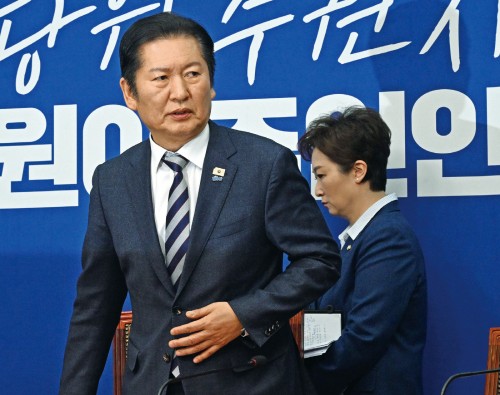 |
| Democratic Party leader Jung Cheong-rae (left) attends a Supreme Council meeting at the National Assembly on Feb. 9. At right is Supreme Council member Lee Eon-ju. / Song Eui-joo |
Talks on a possible merger between the Democratic Party of Korea and the Rebuilding Korea Party are increasingly unraveling, as leadership friction and policy differences deepen roughly 20 days after discussions were launched in the name of winning the June 3 local elections.
The debate was set in motion by Democratic Party leader Jung Cheong-rae, but tensions have mounted rather than eased. Rebuilding Korea Party leader Cho Kuk has issued what amounts to an ultimatum, calling for a decision by Feb. 13, while Democratic Party leaders appear consumed by internal discord ahead of any formal conclusion.
Critics say the push for unity—framed as essential for electoral victory—has instead accelerated divisions within the broader ruling camp.
Jung has pressed ahead citing the “will of party members,” yet failed to secure sufficient prior consensus even within his own Supreme Council. Matters worsened after an internal party office document outlining a merger “roadmap” was leaked on Feb. 6. The document reportedly specified a March 3 completion date and the allocation of appointed Supreme Council seats to the Rebuilding Korea Party, prompting internal opponents to label the plan a “closed-door deal.”
Supreme Council members including Lee Eon-ju, Hwang Myung-seon and Kang Deuk-gu accused the leadership of predetermining the outcome and reducing members to rubber stamps. Explanations that the roadmap was merely a working-level review did little to quell accusations of a prearranged process.
Another major obstacle is a clear divergence in policy direction. Since its founding, the Rebuilding Korea Party has championed legislation based on a “new land public ownership” concept. The stance clashes head-on with the Democratic Party’s current emphasis on centrist pragmatism under the Lee Jae-myung administration.
Lee Eon-ju criticized the proposal as constitutionally questionable and ideologically extreme, warning that an early merger could saddle the governing party with constant policy clashes. Cho dismissed the criticism as ideological labeling more typical of the conservative opposition, igniting a broader debate before party members were even consulted.
Veteran Democratic Party lawmaker Park Jie-won urged restraint, saying in a recent interview that Cho would have been better served by making cooperative remarks while the prospective partner party remained unsettled.
Cho’s Feb. 13 deadline is widely viewed as procedurally unrealistic, fueling speculation that it serves as an exit strategy rather than a genuine push to finalize a merger. Jung’s leadership has also taken a hit, with critics arguing that the episode has highlighted discord between party factions and even with core pro-Lee organizations.
The Democratic Party plans to announce its final position after a lawmakers’ meeting on Feb. 10. Yet with allegations of secret deals and ideological mudslinging already dominating the discourse, many observers expect the talks to collapse.
Park said senior lawmakers largely favored caution at a recent luncheon meeting, adding that prolonging the turmoil would undermine the governing party’s responsibility to the public.
#Democratic Party #Rebuilding Korea Party #party merger talks #Jung Cheong-rae #Cho Kuk
Copyright by Asiatoday
Most Read
-
1
Trump shares map on social media labeling Strait o..

-
2
Kia Sportage outperforms Mazda CX-5 in German auto..

-
3
Houthis launch successive attacks on Saudi airport..

-
4
U.S. deploys carrier, 10,000 more troops to Middle..

-
5
Trump rejects Iran's offer to open Strait of Hormu..

-
6
N. Korea conducts first swarm attack drill with dr..

-
7
U.S.-China summit falls short on substance as Trum..

PEOPLE






HEADLINE NEWS
- Seoul dismisses Ukraine's claim of 'S. Korean support for Russia' as "inaccurate and inappropriate"
- S. Korea, Japan race to develop nuclear-powered submarines
- Henri Kagan, Kenso Soai win Nobel Prize in Chemistry for uncovering how mol..
- Vance says Alaska LNG cooperation will move forward with Seoul's current or..

-
Address : In-Young Bldg., 34, Uisadang-daero 1-gil, Yeongdeungpo-gu, Seoul
Copyright by ASIATODAY CO., LTD. All rights resereved