



Ruling, opposition clash over U.S. tariffs
Feb 10, 2026, 08:16 am


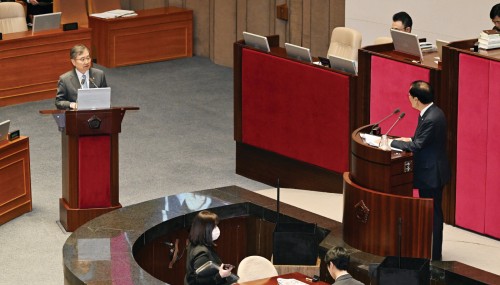 |
| Foreign Minister Cho Hyun (left) answers a question from Democratic Party lawmaker Yoon Hu-deok during a government interpellation on politics, diplomacy, unification, and security at the National Assembly on Feb. 9. / Song Eui-joo |
South Korea’s ruling and opposition parties traded barbs on Monday over U.S. trade issues and the prospect of renewed tariff hikes, as three days of government interpellations began at the National Assembly.
The Democratic Party of Korea urged a pragmatic, balanced diplomatic approach to safeguard national interests, while the People Power Party pressed the government to respond more forcefully to the risk of higher U.S. tariffs.
Democratic Party lawmaker Yoon Hu-deok said global order is being shaken by U.S.-China rivalry, weakening free trade and the multilateral system centered on the United Nations. “South Korea must present an answer that allows it to keep growing without losing its way,” he said. Fellow party member Park Jeong praised what he called diplomacy rooted in cooperation and pragmatism, arguing it has helped restore foreign relations and accelerate economic recovery.
By contrast, People Power Party lawmaker Yoon Sang-hyun criticized the government over U.S. tariff policy. He noted that the Trump administration had indicated plans to publish an executive order raising tariffs from 15 percent to 25 percent, arguing that “this would not happen if the agreement were truly sound.” He also questioned why bills such as the special counsel act and labor legislation were rushed through while a special act on U.S.-bound investment—closely tied to national interests—remained stalled.
Foreign Minister Cho Hyun said a U.S. government negotiating team would visit South Korea later this month, but cautioned that the timing of any tariff re-hike executive order being published in the official gazette remains uncertain.
Responding to Yoon’s question about a February visit, Cho said he had confirmed during talks with the U.S. secretary of state that a cross-agency American team would come to Seoul this month. He added that South Korea had “strongly conveyed” its position that trade issues should not spill over into security negotiations.
Cho acknowledged, however, that it is difficult to predict when a tariff re-hike order might be gazetted. He said Jamieson Greer, the U.S. trade representative, warned that without improvements to South Korea’s non-tariff barriers, Washington would raise tariffs to address the trade deficit, a view Cho described as “the wrong approach” after a lengthy exchange.
The foreign minister added that Seoul had explained in detail steps it could take even before the passage of a special act on U.S.-bound investment, easing misunderstandings in Washington. He said the U.S. secretary of state expressed understanding and that both governments agreed to manage the situation closely going forward.
#U.S. trade #tariff re-hike #government interpellation #Democratic Party #People Power Party
Copyright by Asiatoday
Most Read
-
1
Trump shares map on social media labeling Strait o..

-
2
Kia Sportage outperforms Mazda CX-5 in German auto..

-
3
Houthis launch successive attacks on Saudi airport..

-
4
U.S. deploys carrier, 10,000 more troops to Middle..

-
5
Trump rejects Iran's offer to open Strait of Hormu..

-
6
N. Korea conducts first swarm attack drill with dr..

-
7
U.S.-China summit falls short on substance as Trum..

PEOPLE


HEADLINE NEWS
- Seoul dismisses Ukraine's claim of 'S. Korean support for Russia' as "inaccurate and inappropriate"
- S. Korea, Japan race to develop nuclear-powered submarines
- Henri Kagan, Kenso Soai win Nobel Prize in Chemistry for uncovering how mol..
- Vance says Alaska LNG cooperation will move forward with Seoul's current or..

-
Address : In-Young Bldg., 34, Uisadang-daero 1-gil, Yeongdeungpo-gu, Seoul
Copyright by ASIATODAY CO., LTD. All rights resereved