



PPP adopts party-wide votes, contribution scores
Feb 10, 2026, 08:16 am


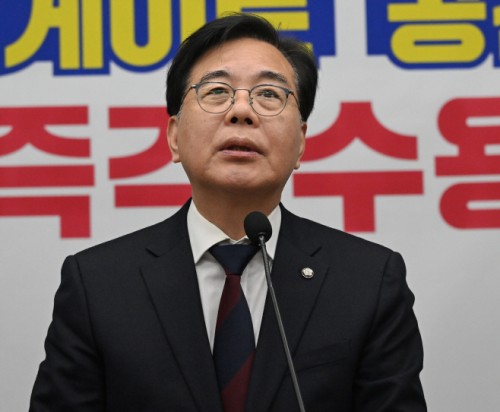 |
| Song Eon-seok, floor leader of the People Power Party, speaks during a lawmakers’ meeting at the National Assembly on Feb. 9. / Song Eui-joo |
South Korea’s main opposition People Power Party (PPP) said Sunday it will introduce party-wide votes for major policy decisions and add a “party contribution” metric to its candidate nomination reviews, as part of a broader overhaul of internal rules.
Choi Soo-jin, the PPP’s senior spokesperson, told reporters after a lawmakers’ meeting that the party will apply the contribution assessment to nominations for both National Assembly races and local executive posts. Under the party constitution and bylaws, the maximum weight of the metric will be capped at 20 points, while detailed criteria will be set by the nomination management committee.
She noted that even in races where two or three young candidates compete, the 20-point ceiling could significantly influence outcomes, adding that the committee will establish specific sub-criteria for implementation.
The party also decided that if a supreme council member steps down to run in a local election, it will proceed directly to a by-election rather than shifting to an emergency leadership committee, aiming to reduce disruption and ensure continuity.
Eligibility requirements for “responsible party members” will be tightened. The minimum dues-payment period will be extended from three months to six months within a year. To ease the transition, the change will take effect after local elections, starting July 1.
In addition, the PPP will introduce a mandatory youth quota for metropolitan and basic council elections. For basic local government heads in districts or cities with populations of 500,000 or more, candidates will be recommended by the central nomination committee. Strategic districts will also adopt “open audition”–style primaries. These measures are included in proposed amendments to party rules.
At the meeting, PPP floor leader Song Eon-seok said the party will rigorously scrutinize key issues during interpellations, including South Korea–U.S. relations, housing policy, food prices ahead of the Lunar New Year, concerns over a hastily pursued administrative integration plan, and the stalled investigation into the Muan airport passenger plane disaster.
Song added that obstacles remain across multiple areas of bilateral ties—citing a proposed special act on U.S.-bound investment, the Coupang issue, and the Telecommunications Business Act—and urged the government to explain its positions candidly to ease public concerns.
He also criticized President Lee Jae-myung for repeatedly addressing housing policy on social media. “The president has been pouring out unrefined, rough remarks on real estate day and night,” Song said, arguing that past experience under previous administrations shows governments cannot overpower markets. He called for a strict review of what he described as “directionless” housing measures.
#People Power Party #party-wide vote #candidate nomination
Copyright by Asiatoday
Most Read
-
1
Trump shares map on social media labeling Strait o..

-
2
Kia Sportage outperforms Mazda CX-5 in German auto..

-
3
Houthis launch successive attacks on Saudi airport..

-
4
U.S. deploys carrier, 10,000 more troops to Middle..

-
5
Trump rejects Iran's offer to open Strait of Hormu..

-
6
N. Korea conducts first swarm attack drill with dr..

-
7
U.S.-China summit falls short on substance as Trum..

PEOPLE





HEADLINE NEWS
- Seoul dismisses Ukraine's claim of 'S. Korean support for Russia' as "inaccurate and inappropriate"
- S. Korea, Japan race to develop nuclear-powered submarines
- Henri Kagan, Kenso Soai win Nobel Prize in Chemistry for uncovering how mol..
- Vance says Alaska LNG cooperation will move forward with Seoul's current or..

-
Address : In-Young Bldg., 34, Uisadang-daero 1-gil, Yeongdeungpo-gu, Seoul
Copyright by ASIATODAY CO., LTD. All rights resereved