



Party–presidency rift grows over prosecution reform
Feb 09, 2026, 08:06 am


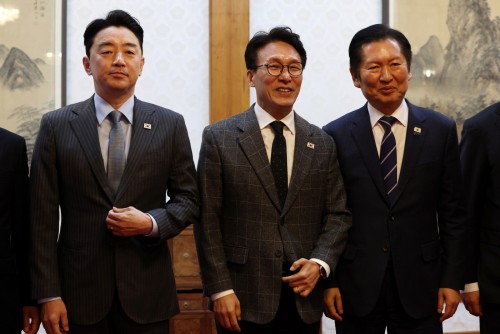 |
| Prime Minister Kim Min-seok, Democratic Party leader Jeong Cheong-rae, and presidential chief of staff Kang Hoon-sik pose for a photo at a high-level party–government meeting at the prime minister’s residence in Seoul on Feb. 8. / Photo by Song Eui-joo |
Signs of strain are mounting between the ruling party and the presidential office as discord emerges over prosecutorial reform and the launch of a second comprehensive special prosecutor investigation, raising concerns that party–government relations are entering a more turbulent phase.
On Saturday, the presidential office said President Lee Jae-myung’s decision to appoint Kwon Chang-young, a lawyer recommended by the Cho Kuk Innovation Party, as a special prosecutor was made after “considering multiple factors.”
The statement followed media reports suggesting the president had expressed strong displeasure over the Democratic Party of Korea’s recommendation of attorney Jeon Jun-cheol—who previously represented former Ssangbangwool Group chairman Kim Sung-tae in an illegal North Korea remittance case—as a candidate for the second special prosecutor probe. The presidential office moved quickly to tamp down speculation.
Even so, observers say the episode underscores deeper rifts between the party and the administration, which have already surfaced over issues such as whether to grant supplementary investigation powers to the proposed public prosecution office and how to handle merger talks with the Cho Kuk Innovation Party.
A presidential office official cautioned against overinterpretation, saying it was “not appropriate to attach political meaning or interpretation” to the appointment of the second special prosecutor.
Shortly after that message, Democratic Party leader Jeong Cheong-rae issued an apology through chief spokesperson Park Soo-hyun. Jeong said controversy had arisen over the president’s exercise of appointment authority and acknowledged a failure in the party’s vetting process, adding that he was sorry for causing the president any burden.
Pro-Lee lawmakers within the Democratic Party sharply criticized Jeong over the recommendation of Jeon Jun-cheol. Rep. Park Hong-geun wrote on social media that it was “a betrayal and insult to the president” to put forward, as a special prosecutor nominee, a former prosecutor who he said had sided with efforts to politically target Lee.
While both the presidential office and party leadership sought to contain the fallout, recent developments have fueled talk that relations are increasingly fraught. One notable example cited by critics is the party’s decision to overhaul much of the government’s prosecutorial reform plan—despite President Lee’s view that supplementary investigation powers for prosecutors may be “exceptionally necessary”—by moving to deny such powers to the new public prosecution office.
When asked about the abolition of supplementary investigation authority, a senior presidential office official said simply that there was “no position,” a response widely interpreted as signaling discomfort with the ruling party’s stance.
Discontent is also said to be growing within the presidential office over how the party leadership is pursuing potential merger talks with the Cho Kuk Innovation Party. Earlier this month, Prime Minister Kim Min-seok remarked at a press briefing that, regardless of whether a merger proceeds, it is “common sense” to avoid internal disputes that could undermine governance—comments seen by many as reflecting the president’s thinking.
As disagreements pile up across key policy fronts, political watchers warn that unless coordination improves, frictions between the party and the presidency could further complicate the administration’s legislative and reform agenda.
#prosecutorial reform #comprehensive special prosecutor #Democratic Party of Korea #presidential office #party–government relations
Copyright by Asiatoday
Most Read
-
1
Trump shares map on social media labeling Strait o..

-
2
Kia Sportage outperforms Mazda CX-5 in German auto..

-
3
Houthis launch successive attacks on Saudi airport..

-
4
U.S. deploys carrier, 10,000 more troops to Middle..

-
5
Trump rejects Iran's offer to open Strait of Hormu..

-
6
N. Korea conducts first swarm attack drill with dr..

-
7
U.S.-China summit falls short on substance as Trum..

PEOPLE




HEADLINE NEWS
- Seoul dismisses Ukraine's claim of 'S. Korean support for Russia' as "inaccurate and inappropriate"
- S. Korea, Japan race to develop nuclear-powered submarines
- Henri Kagan, Kenso Soai win Nobel Prize in Chemistry for uncovering how mol..
- Vance says Alaska LNG cooperation will move forward with Seoul's current or..

-
Address : In-Young Bldg., 34, Uisadang-daero 1-gil, Yeongdeungpo-gu, Seoul
Copyright by ASIATODAY CO., LTD. All rights resereved