



Government, doctors clash on admissions increase
Feb 09, 2026, 08:06 am


 |
A renewed confrontation between the government and the medical community is escalating as a decision on expanding medical school admissions draws near, with both sides maintaining hardline positions over the scale and method of the increase.
The government argues that expanding enrollment is unavoidable to address a long-term shortage of physicians, while medical groups oppose the plan, questioning the credibility of workforce estimates and warning of deteriorating educational conditions. With disagreements over both the pace and structure of expansion unresolved, concerns are growing that the policy dispute could intensify further. As academic calendars leave little room for delay, attention is focused on what conclusion the government will reach.
According to officials and medical groups on Saturday, the Ministry of Health and Welfare plans to convene the seventh meeting of the Health Policy Review Committee on Feb. 10 to finalize the size of medical school admissions increases for the 2027–2031 academic years.
At the sixth meeting held on Feb. 6, discussions continued on physician training capacity but failed to produce an agreement.
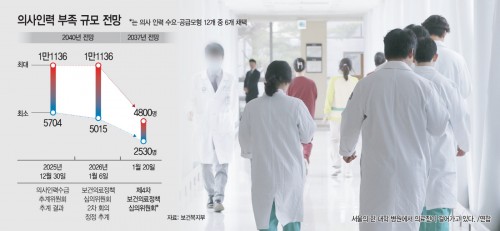
The estimates guiding the committee’s deliberations were finalized late last year by the physician workforce supply-and-demand estimation panel. The panel presented 12 scenarios combining six demand models and two supply models, from which the committee selected three combinations centered on a single supply model. Based on these, the projected physician shortfall in 2037 was narrowed to between 4,262 and 4,800.
Citing this projected gap, the government has emphasized the need for expanding admissions. It decided, however, to exclude an estimated 600 graduates expected from a planned public medical graduate school and from newly established medical schools in regions without existing programs, which are set to begin enrolling students from the 2030 academic year.
After accounting for that exclusion, the scope of expansion under discussion for 32 non-Seoul medical schools currently in operation falls to between 3,662 and 4,200 seats. If filled evenly over five years starting in the 2027 academic year, the annual increase would range from 732 to a maximum of 840 students. The actual figure could be lower, as the government plans to cap increases by institution to prevent excessive strain on educational resources.
The government also said that any admissions exceeding the 2026 intake of 3,058 students would be filled exclusively through a regional doctors program.
Medical groups, however, continue to strongly oppose the plan. The Korea Medical Association called the move a “hasty decision the field cannot absorb,” demanding a halt to expansion and warning of possible large-scale protests if the government proceeds on what it called flawed estimates and distorted data.
Medical educators have highlighted worsening training conditions as their primary concern. The national association of medical school professors said that increasing student numbers by hundreds at institutions already operating at capacity would “institutionalize overcrowded education,” and urged the government to defer any decision until verification materials for the estimates are made public. Professors have also demanded that the government present year-by-year assessments of educational and training capacity for 2027–2031, along with measures to improve compensation for essential medical services and expand training infrastructure.
Despite the pushback, the government said it will reach a conclusion this week. Health and Welfare Minister Jung Eun-kyeong said that while deciding the scale of physician training is important, the government will also prepare accompanying measures to address crises in regional, essential, and public healthcare.
#medical school admissions #doctor shortage #Health and Welfare Ministry #Korea Medical Association
Copyright by Asiatoday
Most Read
-
1
Celltrion’s Omlyclo gains ground in major European..

-
2
Trump demands rates fall below 1% as Fed hikes for..

-
3
Hyundai Motor Group breaks ground on integrated st..

-
4
U.S. strikes 3 Iranian oil tankers, Iran vows reta..

-
5
Trump makes $1 trillion bet ahead of midterm elect..

-
6
Iran resumes ballistic missile production, assembl..

-
7
Samsung Electronics, Mistral AI to jointly develop..

PEOPLE







-
Address : In-Young Bldg., 34, Uisadang-daero 1-gil, Yeongdeungpo-gu, Seoul
Copyright by ASIATODAY CO., LTD. All rights resereved