



U.S. Congress names Lee in Coupang subpoena
Feb 09, 2026, 08:06 am


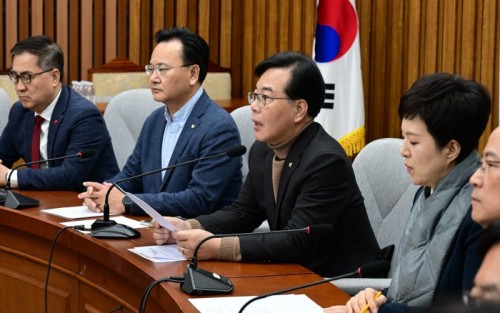 |
| Opposition lawmakers criticized the government after U.S. congressional subpoena documents named President Lee Jae-myung in connection with an inquiry involving Coupang. / Photo by Lee Byung-hwa |
South Korea’s main opposition party on Saturday demanded a government explanation after the U.S. House of Representatives issued a subpoena to the interim head of Coupang’s Korea unit that explicitly named President Lee Jae-myung in related documents.
The People Power Party called the episode a “national embarrassment,” arguing that the inclusion of the president’s name in a foreign legislature’s subpoena raises serious questions about the government’s handling of the matter.
Choi Bo-yoon, the party’s senior spokesperson, said the public deserves to know what the administration and the presidential office did before the president’s name appeared in an overseas congressional document. “How did it come to this?” she asked, criticizing what she described as a failure of advance management.
According to Choi, the subpoena lists specific actions by South Korean authorities—including measures by the Fair Trade Commission—along with the president’s public remarks, references to possible business suspensions, large-scale investigations, and repeated requests for materials. She said the issue has escalated beyond an individual case involving Coupang into a formal matter for the U.S. Congress, driven in part by the administration’s public messaging.
Choi added that the document quoted President Lee as calling for “strong punishment and massive fines.” She stressed that the core of the Coupang case is alleged data leaks that harmed South Korean citizens, noting that data protection should apply regardless of nationality. However, she said the dispute has been reframed internationally as alleged discrimination against a U.S. company, turning it into an official concern of the U.S. legislature.
“At this point, a responsible explanation should come from the presidential chief of staff or the national security adviser,” Choi said, also calling on the prime minister to respond. She criticized the silence following earlier assurances that a bilateral “hotline” with the United States was in operation.
Choi further warned that sensitive issues—including tariff talks, regulation of technology companies, and platform legislation—are unfolding simultaneously in South Korea–U.S. relations. She argued that the government should have anticipated and proactively managed U.S. concerns, rather than shifting blame to delays in parliamentary legislation.
The controversy follows the U.S. House Judiciary Committee’s decision on Feb. 5 to publish on its website a subpoena sent to Coupang’s interim chief executive Harold Rogers, alleging discriminatory treatment of the company by the South Korean government.
#United States Congress #Coupang #subpoena #Lee Jae-myung #People Power Party
Copyright by Asiatoday
Most Read
-
1
Trump shares map on social media labeling Strait o..

-
2
Kia Sportage outperforms Mazda CX-5 in German auto..

-
3
Houthis launch successive attacks on Saudi airport..

-
4
U.S. deploys carrier, 10,000 more troops to Middle..

-
5
Trump rejects Iran's offer to open Strait of Hormu..

-
6
N. Korea conducts first swarm attack drill with dr..

-
7
U.S.-China summit falls short on substance as Trum..

PEOPLE





HEADLINE NEWS
- Seoul dismisses Ukraine's claim of 'S. Korean support for Russia' as "inaccurate and inappropriate"
- S. Korea, Japan race to develop nuclear-powered submarines
- Henri Kagan, Kenso Soai win Nobel Prize in Chemistry for uncovering how mol..
- Vance says Alaska LNG cooperation will move forward with Seoul's current or..

-
Address : In-Young Bldg., 34, Uisadang-daero 1-gil, Yeongdeungpo-gu, Seoul
Copyright by ASIATODAY CO., LTD. All rights resereved