



Korea’s FORGE dilemma as US-China choice looms
Feb 06, 2026, 07:32 am


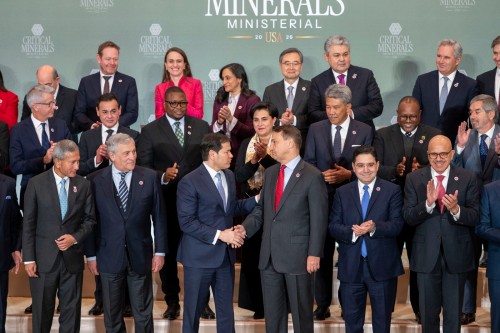 |
| Foreign Minister Cho Hyun (back row, fourth from right) poses for a photo with U.S. Secretary of State Marco Rubio (front row, third from left) at a ministerial meeting on critical minerals hosted by the U.S. State Department in Washington, D.C., on Feb. 4. / AP-Yonhap |
South Korea faces a growing strategic dilemma after assuming the chairmanship of the Forum on Geostrategic Resource Engagement (FORGE), with concerns mounting that Seoul could eventually be pressed to choose between the United States and China.
The Ministry of Foreign Affairs said Thursday that South Korea has taken over as chair of FORGE, a U.S.-centered platform for cooperation on critical minerals. Korea, which had chaired the Minerals Security Partnership (MSP), will lead FORGE through June. As Seoul has recently sought to improve relations with Beijing—including signing a memorandum of understanding on supply chain stability following a Korea–China summit in January—analysts warn the country could be forced into a binary choice between Washington and Beijing.
According to the ministry, MSP was relaunched as FORGE at the first ministerial meeting on critical minerals held Wednesday in Washington, D.C. Marco Rubio said after the meeting that securing “reliable global supply chains” is essential, adding that such supply chains are currently “concentrated in the hands of one country” and could be used as leverage in the worst case—remarks widely seen as targeting China.
Diplomatic sources said MSP, a multilateral consultative body formed under the Biden administration, had been under review by the Trump administration. With critical mineral supply chains emerging as a pressing global issue, the Trump administration opted to expand and relaunch the framework as FORGE. The existing 17 MSP member states, including South Korea, will continue cooperation under the new forum.
Cho Hyun, who attended the meeting, welcomed the launch of FORGE and pledged, as chair, to expand cooperation among member states and pursue practical joint projects. He outlined priorities including promoting investment in critical mineral projects, strengthening coordination among members, enhancing communication among stakeholders, and building a platform to advance cooperation on mineral recycling.
The government said it is reviewing U.S. proposals for deeper bilateral cooperation, such as memoranda of understanding and participation in a so-called “critical minerals trade bloc,” reflecting caution amid efforts to improve ties with China.
A foreign ministry official said the United States has signed bilateral MOUs on mineral cooperation with more than 10 countries on the sidelines of the meeting, adding that Seoul is reviewing the proposal. On participation in a minerals trade bloc, the official said it remains “at the idea stage” and that no formal request has been made, noting Korea will closely assess U.S. plans and intentions.
With South Korea now chairing both MSP and FORGE, observers say the country has laid groundwork to diversify and stabilize supply chains for rare earths and other critical minerals. However, as FORGE is effectively aimed at China and Washington pushes a more integrated, U.S.-led framework, concerns persist about potential fallout for Korea–China relations.
Cha Du-hyeon, vice president of the Asan Institute for Policy Studies, said short-term frictions between Korea’s agreements with China and its FORGE cooperation could be managed. “But if extreme U.S.-China supply chain decoupling occurs over the mid to long term,” he warned, “South Korea may ultimately have to make a choice.”
#FORGE #critical minerals #supply chain #South Korea #United States
Copyright by Asiatoday
Most Read
-
1
Trump shares map on social media labeling Strait o..

-
2
Kia Sportage outperforms Mazda CX-5 in German auto..

-
3
Houthis launch successive attacks on Saudi airport..

-
4
U.S. deploys carrier, 10,000 more troops to Middle..

-
5
Trump rejects Iran's offer to open Strait of Hormu..

-
6
N. Korea conducts first swarm attack drill with dr..

-
7
U.S.-China summit falls short on substance as Trum..

PEOPLE






HEADLINE NEWS
- Seoul dismisses Ukraine's claim of 'S. Korean support for Russia' as "inaccurate and inappropriate"
- S. Korea, Japan race to develop nuclear-powered submarines
- Henri Kagan, Kenso Soai win Nobel Prize in Chemistry for uncovering how mol..
- Vance says Alaska LNG cooperation will move forward with Seoul's current or..

-
Address : In-Young Bldg., 34, Uisadang-daero 1-gil, Yeongdeungpo-gu, Seoul
Copyright by ASIATODAY CO., LTD. All rights resereved