



Woo Won-shik sets referendum law, constitution as top priorities
Feb 06, 2026, 07:32 am


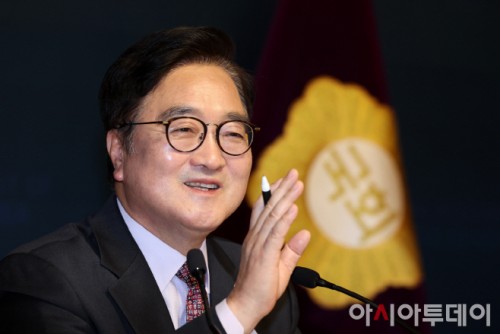 |
| National Assembly Speaker Woo Won-shik holds a New Year press conference at Sarangjae of the National Assembly on Wednesday. / Lee Byung-hwa |
Woo Won-shik said Wednesday that revising the Referendum Act and pursuing constitutional reform would be his top priorities for the remainder of his term, with only four months left in office.
Speaking at a New Year press conference at the National Assembly, Woo said nearly 40 years have passed since South Korea’s ninth constitutional amendment in 1987, yet the Constitution has failed to reflect major social changes such as low birth rates, rapid aging, and regional depopulation. He said he aims to pass revisions to the Referendum Act before the Lunar New Year holiday and then proceed step by step with constitutional amendments agreed upon by both parties.
“Constitutional reform should be carried out in stages, in line with local elections, as agreed,” Woo said, adding that he sees the period around the Lunar New Year as the deadline to revise the Referendum Act to enable a simultaneous vote with local elections.
The Referendum Act provides the legal procedure for directly seeking public approval on major national decisions, including constitutional amendments. However, the law has been effectively invalid since 2016 following a 2014 Constitutional Court ruling of unconstitutionality. Persistent partisan conflict has since prevented its revision.
Given that revising the Referendum Act is a prerequisite for constitutional reform, Woo said he plans to prioritize passage of the law before accelerating amendment efforts. “There are many gaps in our Constitution,” he said. “Over the past 40 years, our society has undergone major changes such as low birth rates and an aging population, but the Constitution does not contain the spirit needed to respond to these challenges.”
Woo also expressed expectations for a more proactive stance from the ruling People Power Party on constitutional reform, noting party leader Jang Dong-hyuk’s recent mention of relocating the administrative capital to Sejong City in a floor speech. “To relocate the administrative capital, a constitutional amendment is required, and for that, the Referendum Act is necessary,” Woo said. He added that he was “surprised” by the remarks, while noting that floor leader Song Eon-seok has raised concerns about the timing of constitutional reform.
Addressing criticism over the slow pace of legislation, Woo said he would work to narrow differences by listening to both sides. Since the opening of the 22nd National Assembly, the bill passage rate stands at 22.5 percent, lower than the same period in the 21st Assembly (28.7 percent) and the 20th (23.9 percent). President Lee Jae-myung recently rebuked the Assembly over legislative delays.
“While it is true that extraordinary circumstances such as martial law and an early presidential election made it difficult to review and pass bills, the lives of the people do not wait,” Woo said. “If bills that safeguard people’s livelihoods are not processed, their lives become harder.”
Woo also criticized the abuse of the filibuster, or unlimited debate, saying it has strayed from its original purpose of persuading public opinion and devolved into a tactic for stalling proceedings. “A genuine filibuster should be well prepared and capable of persuading the public,” he said. “When speeches are completely unrelated to the topic, one has to ask why it is being done at all. Abnormal filibusters should be brought to an end as soon as possible.”
#Woo Won-shik #National Assembly #referendum law #constitutional amendment
Copyright by Asiatoday
Most Read
-
1
Trump shares map on social media labeling Strait o..

-
2
Kia Sportage outperforms Mazda CX-5 in German auto..

-
3
Houthis launch successive attacks on Saudi airport..

-
4
U.S. deploys carrier, 10,000 more troops to Middle..

-
5
Trump rejects Iran's offer to open Strait of Hormu..

-
6
N. Korea conducts first swarm attack drill with dr..

-
7
U.S.-China summit falls short on substance as Trum..

PEOPLE





HEADLINE NEWS
- Seoul dismisses Ukraine's claim of 'S. Korean support for Russia' as "inaccurate and inappropriate"
- S. Korea, Japan race to develop nuclear-powered submarines
- Henri Kagan, Kenso Soai win Nobel Prize in Chemistry for uncovering how mol..
- Vance says Alaska LNG cooperation will move forward with Seoul's current or..

-
Address : In-Young Bldg., 34, Uisadang-daero 1-gil, Yeongdeungpo-gu, Seoul
Copyright by ASIATODAY CO., LTD. All rights resereved