



Jang proposes tax breaks, voting age cut
Feb 05, 2026, 08:18 am


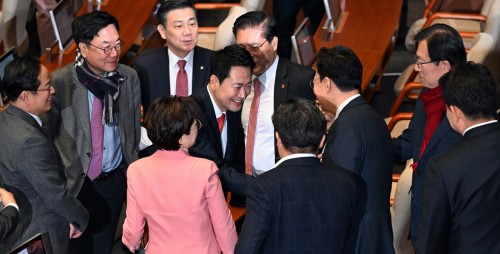 |
| Jang Dong-hyuk, leader of the People Power Party, greets fellow lawmakers after delivering a parliamentary address at the National Assembly on Tuesday. / Song Eui-joo |
Jang Dong-hyuk, leader of the People Power Party, on Tuesday pledged sweeping incentives aimed at reviving the economy, including inheritance tax exemptions for companies relocating outside the capital region and zero-interest loan forgiveness for families with three children. He also made a surprise proposal to lower the voting age to 16 starting from the June 3 local elections.
In his first parliamentary floor speech since taking office, Jang said he would “take the lead in opening the road to tomorrow,” placing strong emphasis on youth, newly married couples, and businesses. His address outlined a vision to ease regulatory pressure on companies and encourage population and corporate relocation to regional areas.
Targeting young people and newlyweds as key policy beneficiaries, Jang signaled an effort to broaden the party’s support base. For younger generations, he proposed a “2030 life-cycle policy package,” including regional joint dormitories, convenience-store meal vouchers, and legislation to promote fair hiring practices.
To ease housing burdens, Jang pledged to introduce measures such as family-oriented loan programs, a special account for population growth, and a Korean-style family tax rate system. Under the plan, newly married, first-time homebuyers within three years of marriage who have three children would be eligible for full loan and principal forgiveness, up to 200 million won.
On what he described as a “regional revolution,” Jang criticized the stigma attached to Seoul residents purchasing homes outside the capital, promising to promote second-home ownership in provincial areas. He said buyers acquiring homes priced at 600 million won or less would be able to do so without tax concerns, allowing them to use the properties as weekend farms or private workspaces.
Jang also outlined measures to boost economic growth, including a party-backed bill to delay the implementation of the so-called Yellow Envelope Act by one year. He further promised full inheritance tax exemptions for companies that relocate to regional areas and maintain employment for at least 10 years.
Addressing the ruling camp, Jang called for the acceptance of three special prosecutors’ investigations, including cases related to election bribery and other political controversies. To tackle pressing issues such as the weak won, housing instability, and U.S. tariffs, he proposed a leadership summit and the creation of a parliamentary “Korea Renovation Task Force.”
Political observers noted that the speech underscored Jang’s determination to reclaim initiative in national politics and expand the party’s appeal. During the address, lawmakers responded with applause on 36 occasions.
Eom Gyeong-yeong, head of the Zeitgeist Research Institute, said the proposal for three special prosecutors directly targets vulnerabilities within the ruling bloc, reflecting an effort to regain political leadership. He added that the focus on youth and businesses is aimed at strengthening support among centrist conservative voters, where the party has traditionally been weaker.
#Jang Dong-hyuk #People Power Party #inheritance tax exemption #regional relocation
Copyright by Asiatoday
Most Read
-
1
Trump shares map on social media labeling Strait o..

-
2
Kia Sportage outperforms Mazda CX-5 in German auto..

-
3
Houthis launch successive attacks on Saudi airport..

-
4
U.S. deploys carrier, 10,000 more troops to Middle..

-
5
Trump rejects Iran's offer to open Strait of Hormu..

-
6
N. Korea conducts first swarm attack drill with dr..

-
7
U.S.-China summit falls short on substance as Trum..

PEOPLE






HEADLINE NEWS
- Seoul dismisses Ukraine's claim of 'S. Korean support for Russia' as "inaccurate and inappropriate"
- S. Korea, Japan race to develop nuclear-powered submarines
- Henri Kagan, Kenso Soai win Nobel Prize in Chemistry for uncovering how mol..
- Vance says Alaska LNG cooperation will move forward with Seoul's current or..

-
Address : In-Young Bldg., 34, Uisadang-daero 1-gil, Yeongdeungpo-gu, Seoul
Copyright by ASIATODAY CO., LTD. All rights resereved