



Party vote boosts Jeong’s reelection, merger drive
Feb 04, 2026, 07:41 am


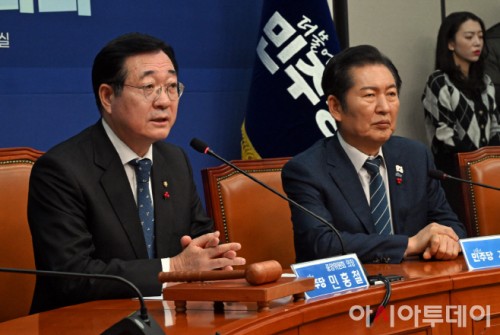 |
| Min Hong-cheol, chair of the Democratic Party Central Committee, speaks during the party’s fourth Central Committee meeting at the National Assembly in December last year, as party leader Jeong Cheong-rae looks on. / Song Eui-joo |
The Central Committee of South Korea’s ruling Democratic Party of Korea on Feb. 3 approved a revision to its party charter introducing a “one member, one vote” system, a move expected to bolster party leader Jeong Cheong-rae’s bid for a second term and his push for a merger with the Rebuilding Korea Party.
According to the party’s central election management committee, 515 of 590 registered Central Committee members participated in the online vote, marking a turnout of 87.29 percent. Of those, 312 members, or 60.58 percent, voted in favor of the amendment, while 203, or 39.42 percent, opposed it. The measure passed with a simple majority, overcoming the lack of quorum that sank a similar vote in December.
Senior party spokesperson Park Soo-hyun said in a written briefing after the vote that the amendment carries historic significance. “This is not a mere rule change but the first institutional realization of party member sovereignty through one member, one vote,” he said, adding that Jeong demonstrated that “acceptance and deliberation are the strongest forms of leadership.”
The core of the revision is the equalization of voting power between delegates and rank-and-file party members, replacing a system under which delegate votes could carry up to 20 times the weight of ordinary members’ ballots. The change is widely seen as weakening delegate blocs aligned with sitting lawmakers and local party chairs, while amplifying the influence of highly mobilized party members.
The reform is viewed as central to what critics call the “Jeong Cheong-rae plan,” aimed at securing his reelection at the party convention in August. With relatively weaker support among delegates, Jeong is expected to benefit from the new rules as he potentially faces rivals aligned with pro-Lee Jae-myung factions, including Prime Minister Kim Min-seok. Absorbing members of the Rebuilding Korea Party through a merger is also seen as key to expanding his support base.
However, backlash within the party is growing. Pro-Lee Jae-myung lawmakers and first-term legislators have criticized the vote as a rushed process that undermines procedural democracy. Supreme Council member Lee Eon-ju warned during the voting period that a “speed-first approach without sufficient deliberation turns party members into rubber stamps.”
Jang Jong-tae, head of the first-term lawmakers’ caucus, also pushed back at an emergency meeting, saying that even if the intent of the reform is sound, “the current process and methods are difficult to accept.”
In response, Jeong has begun reaching out to critics. He recently met individually with lawmakers who oppose both the voting reform and the proposed merger, including a private lunch meeting with Lee. Supreme Council member Hwang Myung-sun reiterated in a YouTube interview that the political situation should be stabilized first and that “a merger should not take place before the local elections.”
Jeong is expected to continue consultations by gathering opinions from party members across all 17 provinces and cities, while also holding a series of meetings with second- and third-term lawmakers as part of efforts to ease internal tensions.
#Democratic Party #one member one vote #party charter revision #Jeong Cheong-rae
Copyright by Asiatoday
Most Read
-
1
Trump shares map on social media labeling Strait o..

-
2
Kia Sportage outperforms Mazda CX-5 in German auto..

-
3
Houthis launch successive attacks on Saudi airport..

-
4
U.S. deploys carrier, 10,000 more troops to Middle..

-
5
Trump rejects Iran's offer to open Strait of Hormu..

-
6
N. Korea conducts first swarm attack drill with dr..

-
7
U.S.-China summit falls short on substance as Trum..

PEOPLE






HEADLINE NEWS
- Seoul dismisses Ukraine's claim of 'S. Korean support for Russia' as "inaccurate and inappropriate"
- S. Korea, Japan race to develop nuclear-powered submarines
- Henri Kagan, Kenso Soai win Nobel Prize in Chemistry for uncovering how mol..
- Vance says Alaska LNG cooperation will move forward with Seoul's current or..

-
Address : In-Young Bldg., 34, Uisadang-daero 1-gil, Yeongdeungpo-gu, Seoul
Copyright by ASIATODAY CO., LTD. All rights resereved