



Ruling, opposition parties torn by infighting before elections
Feb 04, 2026, 07:41 am


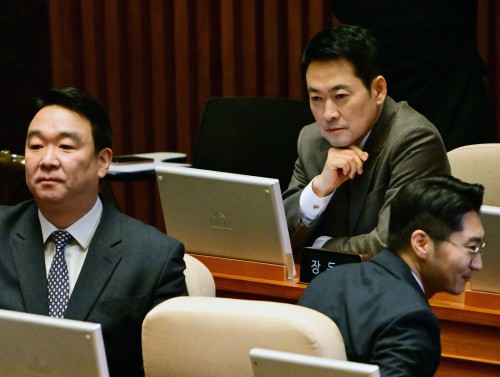 |
| People Power Party leader Jang Dong-hyuk listens to a floor speech by Democratic Party floor leader Han Byung-doo during a National Assembly plenary session on Feb. 3. / Lee Byung-hwa |
South Korea’s two major political parties are grappling with intensifying internal strife, as factional conflicts and disputes over party management and strategy spill into the open ahead of upcoming elections.
Both the Democratic Party and the opposition People Power Party are increasingly consumed by internal power struggles, raising concerns that they are undermining their own political momentum. Political observers note that “internal enemies can be more dangerous than external ones.”
According to political sources on Feb. 3, tensions within both parties have escalated to the point where calls for the resignation of People Power Party leader Jang Dong-hyuk and Democratic Party leader Jeong Cheong-rae are openly circulating.
The core issue fueling the People Power Party’s turmoil is the expulsion of former leader Han Dong-hoon. A lawmakers’ meeting convened at the request of a junior-lawmakers’ group lasted nearly four hours but failed to reach a clear conclusion on the party leadership’s decision. Instead, the session devolved into shouting matches and verbal abuse between pro-leadership figures and lawmakers aligned with Han, laying bare the party’s internal divisions.
The confrontation continued publicly. Pro-Han lawmaker Jung Sung-kook wrote on Facebook that a senior party official had made provocative remarks toward him after the meeting, an allegation the official denied, countering that the issue reflected “arrogance among lawmakers.”
Jang said he would fully cooperate with a police investigation into the controversy that triggered Han’s expulsion and accept political responsibility depending on the outcome, but the infighting has shown little sign of easing.
Reform-minded and pro-Han lawmakers argue that ahead of the June 3 local elections, Jang is pursuing a “politics of subtraction rather than addition,” calling for his resignation or a confidence vote. Kim Yong-tae, who proposed a re-endorsement vote, said the prolonged conflict is spilling over into divisions among supporters.
Jang’s allies have pushed back, branding the criticism as “internal sabotage.” A senior party researcher said the party belongs to its 1.1 million members, not lawmakers, adding that party members are firmly backing Jang.
The Democratic Party is also facing growing turmoil. Jeong’s push to introduce a “one member, one vote” system — aimed at equalizing the voting power of delegates and rank-and-file members — has sparked strong opposition from pro-Lee Jae-myung figures within the party leadership.
Tensions have further escalated after Jeong proposed a merger with the Rebuilding Korea Party, arguing it would help secure victory in local elections. Although he has said the decision should ultimately be left to party members, internal resistance has remained intense.
Political analysts warn that if both parties fail to contain their internal conflicts, they risk weakening organizational strength and alienating supporters as elections approach, potentially costing them the initiative in the broader political landscape.
#party infighting #election politics #Democratic Party #People Power Party #leadership dispute
Copyright by Asiatoday
Most Read
-
1
Trump shares map on social media labeling Strait o..

-
2
Kia Sportage outperforms Mazda CX-5 in German auto..

-
3
Houthis launch successive attacks on Saudi airport..

-
4
U.S. deploys carrier, 10,000 more troops to Middle..

-
5
Trump rejects Iran's offer to open Strait of Hormu..

-
6
N. Korea conducts first swarm attack drill with dr..

-
7
U.S.-China summit falls short on substance as Trum..

PEOPLE





HEADLINE NEWS
- Seoul dismisses Ukraine's claim of 'S. Korean support for Russia' as "inaccurate and inappropriate"
- S. Korea, Japan race to develop nuclear-powered submarines
- Henri Kagan, Kenso Soai win Nobel Prize in Chemistry for uncovering how mol..
- Vance says Alaska LNG cooperation will move forward with Seoul's current or..

-
Address : In-Young Bldg., 34, Uisadang-daero 1-gil, Yeongdeungpo-gu, Seoul
Copyright by ASIATODAY CO., LTD. All rights resereved