



Lee’s pragmatic diplomacy gains traction
Jan 22, 2026, 07:56 am


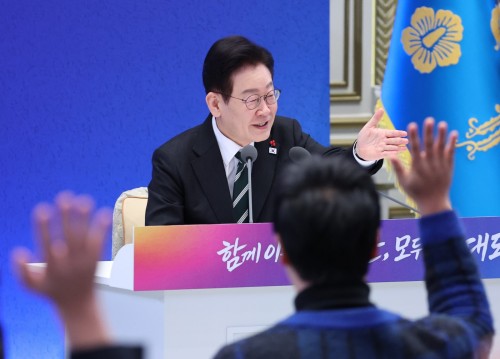 |
| President Lee Jae-myung answers reporters’ questions at a New Year press conference at the State Guest House of Cheong Wa Dae on Jan. 21. / Yonhap |
The first year of the Lee Jae-myung administration’s “national interest–first practical diplomacy” has marked a turning point for the sustainability of South Korea’s foreign policy, analysts say. Surveys suggest the approach has also underpinned President Lee Jae-myung’s steady approval ratings.
Launched in June last year, the administration’s pragmatic diplomacy has helped bring South Korea back to the global stage while expanding diplomatic flexibility through a realistic response to a rapidly shifting international environment.
The previous Yoon Suk Yeol administration was criticized for narrowing diplomatic autonomy by prioritizing values-based diplomacy, which weakened ties with China and Russia and, critics argue, eroded economic interests and leverage over North Korea.
Amid a leadership vacuum following the Dec. 3 martial law episode and the return of U.S. President Donald Trump to the White House—accelerating a broader reshaping of the global order—the Lee government moved quickly to restore South Korea’s diplomatic presence with a pragmatic strategy.
In a report titled “One Year of the Lee Jae-myung Administration: Diplomatic Achievements and Tasks Ahead,” Min Jeong-hoon, a professor at the Korea National Diplomatic Academy, said the most significant achievement of the first year was the normalization of South Korea’s diplomacy.
A centerpiece was the 2025 Asia-Pacific Economic Cooperation (APEC) summit in Gyeongju. South Korea chaired 14 official consultations, mediated differences among member economies, and secured adoption of three key documents—the APEC Leaders’ Declaration, the APEC AI Initiative, and a cooperation framework to address demographic change—demonstrating the substance of practical diplomacy.
Safeguarding the Korean Peninsula and protecting citizens’ lives and property remain South Korea’s core national interests. With North Korea’s advanced nuclear and missile capabilities posing a persistent threat, the Lee administration has strengthened cooperation with the United States.
Built on a solid South Korea–U.S. alliance, the government has also reinforced trilateral cooperation among South Korea, the U.S., and Japan, while separately visiting China and Japan to underscore a results-oriented approach focused on mutual benefit rather than ideology or public sentiment.
Looking ahead, the administration aims to extend its pragmatic diplomacy across the Indo-Pacific and globally—stabilizing relations with the U.S., Japan, and China, while deepening partnerships with ASEAN, the Middle East, and Africa based on openness, inclusiveness, and solidarity.
“Practical diplomacy centered on national interests enables an approach that spans ideological lines and provides a stable policy foundation across domestic political divides,” Min said. “If it continues to leverage Korea’s comparative advantages in trade, advanced technology, development cooperation, energy, defense industries, culture, and people-to-people exchanges, and maintains public support, South Korea can be recognized as a model advanced nation on the world stage.”
#Lee Jae-myung #practical diplomacy #APEC #South Korea–U.S.–Japan cooperation #foreign policy normalization
Copyright by Asiatoday
Most Read
-
1
Trump shares map on social media labeling Strait o..

-
2
Kia Sportage outperforms Mazda CX-5 in German auto..

-
3
Houthis launch successive attacks on Saudi airport..

-
4
U.S. deploys carrier, 10,000 more troops to Middle..

-
5
Trump rejects Iran's offer to open Strait of Hormu..

-
6
N. Korea conducts first swarm attack drill with dr..

-
7
U.S.-China summit falls short on substance as Trum..

PEOPLE





HEADLINE NEWS
- Seoul dismisses Ukraine's claim of 'S. Korean support for Russia' as "inaccurate and inappropriate"
- S. Korea, Japan race to develop nuclear-powered submarines
- Henri Kagan, Kenso Soai win Nobel Prize in Chemistry for uncovering how mol..
- Vance says Alaska LNG cooperation will move forward with Seoul's current or..

-
Address : In-Young Bldg., 34, Uisadang-daero 1-gil, Yeongdeungpo-gu, Seoul
Copyright by ASIATODAY CO., LTD. All rights resereved