



Yoon arrest obstruction ruling set for Jan. 16
Jan 16, 2026, 07:54 am


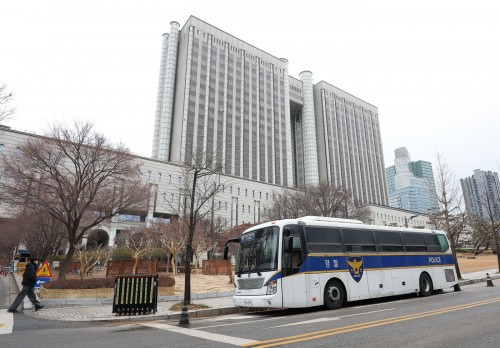 |
| Police buses are parked outside the Seoul Central District Court in Seocho-gu, Seoul, on Jan. 15, one day ahead of the first-instance verdict in the case accusing former President Yoon Suk Yeol of obstructing an arrest. / Yonhap |
A South Korean court will deliver its first ruling Friday in a criminal case against former President Yoon Suk Yeol, a decision widely seen as a bellwether for upcoming trials related to the Dec. 3 martial law episode.
The Seoul Central District Court is set to announce a first-instance verdict on charges that Yoon obstructed the execution of an arrest warrant by the Corruption Investigation Office for High-ranking Officials (CIO), abused his authority, and instructed others to help a suspect evade arrest.
Legal observers say the core issue is whether the CIO had lawful authority to investigate insurrection-related charges and whether the arrest warrant, issued by the court, was executed legally. The court’s determination is expected to shape later proceedings in broader insurrection cases stemming from the martial law declaration.
The criminal panel of the Seoul Central District Court will hand down the verdict on Friday. At closing arguments on Dec. 26, prosecutors sought a combined sentence of 10 years in prison. Given the case’s public importance, the court has approved a live broadcast of the sentencing. It will be the third time a trial involving a former president is aired live, following those of Park Geun-hye and Lee Myung-bak.
The obstruction charge centers on allegations that on Jan. 3 last year, Yoon ordered the presidential security service to block the CIO from executing a court-issued arrest warrant. To establish obstruction of official duties, the court must first determine that the CIO’s warrant execution constituted lawful official action.
Yoon’s defense has consistently argued that the CIO lacks authority to investigate insurrection charges and has sought dismissal of the indictment. However, many legal experts say it would be difficult for the court to deny the legality of the arrest process after having issued the warrant itself.
“Refusing to comply with a court order amounts to a direct denial of the rule of law, regardless of one’s position,” said Lee Heon-hwan, a law professor at Ajou University, predicting a heavy sentence of at least five years.
Lee Chang-hyun, a professor at Hankuk University of Foreign Studies, similarly forecast a prison term of five to seven years, though he noted that disputes such as allegations of “forum shopping” — after the CIO obtained a warrant from the Seoul Western District Court following rejections elsewhere — could still be contested.
Another major issue is whether the declaration of martial law met constitutional and legal procedural requirements. Prosecutors allege that Yoon abused his authority by convening a limited Cabinet meeting ahead of the declaration on Dec. 3, 2024, thereby infringing the deliberation rights of nine ministers who were not summoned. He is also accused of fabricating and later destroying documents to make it appear that the declaration had been properly countersigned.
If the court finds that Cabinet members’ deliberation rights were violated, it would effectively acknowledge that the martial law declaration lacked procedural legitimacy under the Constitution and relevant statutes. Legal experts say such a finding, even at the first-instance level, could serve as an important precedent for future rulings in related insurrection trials.
#Yoon Suk Yeol #arrest obstruction #insurrection trial #Corruption Investigation Office for High-ranking Officials #Seoul Central District Court
Copyright by Asiatoday
Most Read
-
1
Celltrion nears additional contract with major U.S..

-
2
Putin proposes trilateral U.S.-China-Russia summit..

-
3
U.S. weighs dropping MOAB, world's most powerful n..

-
4
"Aren't those foreigners on welfare?": M..

-
5
Attention centers on APEC for possible Trump-Xi-Pu..

-
6
Saudi Arabia, Iran hold first diplomatic talks to..

-
7
U.S., Israel plan to resume strikes on Iran after..

PEOPLE






-
Address : In-Young Bldg., 34, Uisadang-daero 1-gil, Yeongdeungpo-gu, Seoul
Copyright by ASIATODAY CO., LTD. All rights resereved