



Japan visit tests Lee’s pragmatic diplomacy
Jan 12, 2026, 07:49 am


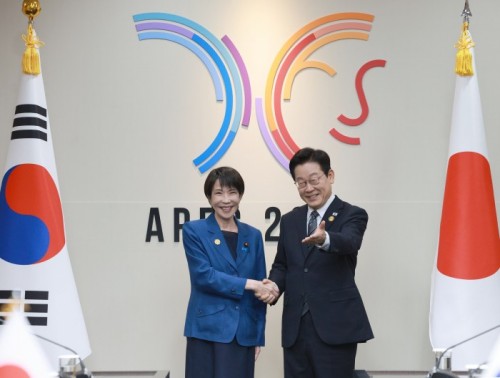 |
| President Lee Jae-myung guides Prime Minister Sanae Takaichi after a photo session at a South Korea–Japan summit on the sidelines of the APEC leaders’ meeting in Gyeongju, North Gyeongsang Province. / Presidential Office Press Pool |
Attention is focusing on how President Lee Jae-myung will present a concrete blueprint for his “national-interest–centered pragmatic diplomacy” as he visits Japan on Jan. 13–14 for a bilateral summit.
Lee’s back-to-back visits to China and Japan early this year are widely seen as underscoring that both are “important partners” for South Korea. Yet some warn that if Seoul’s positioning appears ambiguous as China–Japan frictions intensify, it could risk losing trust from both sides. This is why analysts say the real test of Lee’s pragmatic, interest-first diplomacy will begin in earnest after this month’s South Korea–China and South Korea–Japan summits.
According to the presidential office on Jan. 11, Lee will travel to Nara Prefecture for a two-day, one-night itinerary. On the first day, he will hold one-on-one and expanded talks with Prime Minister Sanae Takaichi, followed by a joint press statement and a dinner. On Jan. 14, the two leaders will visit the cultural heritage site Horyu-ji, after which Lee will meet with members of the Korean community before returning home. This will be Lee’s fifth summit with Japan since taking office and his second meeting with Takaichi.
The presidential office said it expects four major outcomes from the trip: restoration of shuttle diplomacy, stronger practical cooperation, humanitarian cooperation on historical issues, and coordination on regional and global agendas. National Security Adviser Wi Sung-lac said the meeting could serve as an opportunity for the two countries to cooperate on humanitarian aspects of historical issues, including the Josei coal mine, signaling an intent to find a breakthrough in long-standing disputes.
Whether Prime Minister Takaichi will press Lee directly on South Korea’s role while emphasizing trilateral cooperation among South Korea, the United States, and Japan is also drawing attention.
Earlier, Xi Jinping told Lee at a summit on Jan. 5 that South Korea should “stand on the right side of history and make the right strategic choice,” a remark widely interpreted as pressure on Seoul to choose sides amid U.S.–China and China–Japan rivalries. Given that context, some observers believe Takaichi could similarly urge Seoul to clarify its strategic alignment.
Lee deflected Xi’s comment by saying he took it “as a saying of Confucius” and that summits are “a place where each side says what it needs to say.” Still, despite his public stance, officials expect intense internal deliberations after the summits over how best to position South Korea to maximize tangible outcomes from pragmatic diplomacy.
Lee’s Japan trip is also fueling interest in whether South Korea’s bid to join the Comprehensive and Progressive Agreement for Trans-Pacific Partnership (CPTPP) will gain momentum. The CPTPP is a multilateral free trade agreement among Asia-Pacific economies that was launched in 2018 under Japan’s leadership.
#South Korea-Japan summit #Lee Jae-myung #Sanae Takaichi #China-Japan tensions
Copyright by Asiatoday
Most Read
-
1
Celltrion’s Omlyclo gains ground in major European..

-
2
Trump demands rates fall below 1% as Fed hikes for..

-
3
Trump makes $1 trillion bet ahead of midterm elect..

-
4
Iran resumes ballistic missile production, assembl..

-
5
Trump warns countries not helping U.S. must pay re..

-
6
Apple launches first foldable, 1 million won prici..

-
7
Turkish Airlines named main club partner of Liverp..

PEOPLE






-
Address : In-Young Bldg., 34, Uisadang-daero 1-gil, Yeongdeungpo-gu, Seoul
Copyright by ASIATODAY CO., LTD. All rights resereved