



Lee draws line on drone claims, probes civilian use
Jan 12, 2026, 07:49 am


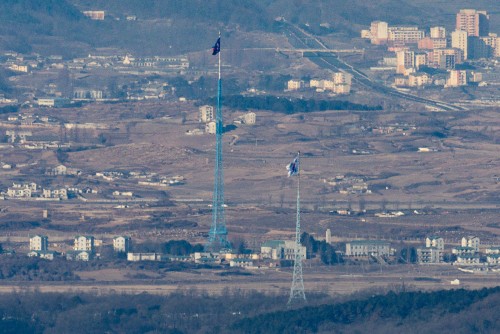 |
| South and North Korean flags flutter in Daeseong-dong village on the southern side and Gijeong-dong village on the northern side of the Demilitarized Zone (DMZ), as seen from the western front-line border area in Paju, Gyeonggi Province, on Jan. 11, amid North Korea’s claims that South Korean drones infiltrated its airspace. / Yonhap |
The government stressed that North Korea’s claim of South Korean drone infiltration was “not a military operation,” saying it would investigate the possibility that a civilian drone was involved. President Lee Jae-myung personally ordered a swift and rigorous probe, instructing authorities to form a joint military–police task force to examine whether civilians operated the drone.
On Jan. 11, Seoul’s response centered on de-escalation—seeking to avoid provoking Pyongyang while calming heightened tensions. In a statement released by the Blue House’s National Security Office, the government said it would “establish the truth through a joint military–police investigation and promptly disclose the results,” adding that it “has no intention to provoke or stimulate the North.” The Blue House convened a working-level National Security Council meeting immediately after the North’s allegation surfaced the previous day.
Notably, President Lee addressed the “possibility of civilian drone operation,” saying that “if true, it would constitute a grave crime threatening peace on the Korean Peninsula and national security.” Analysts note it is unusual for a sitting president to order an investigation into a sensitive inter-Korean military issue using a conditional—“if true”—that effectively directs scrutiny inward before any findings are released, especially while multiple possibilities remain open, including a false claim by the North or involvement by a third party.
The Ministry of National Defense also struck a restrained tone, stating in its position on the North Korean General Staff’s statement that “we have no intention to provoke or stimulate the North,” and pledging to continue practical measures to ease tensions and build trust between the two Koreas.
Defense Policy Director Kim Hong-cheol said preliminary checks show the military does not possess the drone in question and did not operate any drone at the times cited by North Korea. “We will conduct a thorough investigation, in cooperation with relevant agencies, into the possibility that a drone was operated in the civilian sector,” he said.
The Unification Ministry convened an emergency senior officials’ meeting the same day and said it would continue consistent efforts with related agencies to reduce tensions and foster trust between the two Koreas.
Within a day, Pyongyang responded with what it called an assessment of Seoul’s “wise choice,” while also issuing additional demands. Kim Yo-jong, deputy department director of the Workers’ Party of Korea, said in a statement carried by the Korean Central News Agency on Jan. 11 that she would “rate it as a wise choice for survival” that South Korea’s defense ministry publicly stated it had no intention to provoke or stimulate the North.
Kim added that “the essence of the matter does not lie in whether the actor is military or civilian,” asserting that “the undeniable fact is that a South Korean drone violated our national airspace,” and demanded a “specific explanation of the substance.” She also warned that if South Korea “chooses provocation,” it would be unable to bear the “terrible consequences” that would follow.
Earlier, a spokesperson for the Korean People’s Army General Staff claimed that the North had shot down South Korean drones allegedly infiltrated last September and again on Jan. 4, releasing photos of what it said were drone remnants. The spokesperson claimed that on Jan. 4, an aerial target moving northward was detected over an area in Songhae-myeon, Ganghwa County, Incheon, attacked with electronic assets, and forced to crash in the Kaepung area of Kaesong. The statement also alleged that on Sept. 27 last year, a drone took off from Paju, Gyeonggi Province, and intruded into airspace over North Hwanghae Province.
#North Korea #drone infiltration #civilian drone #joint investigation #Lee Jae-myung
Copyright by Asiatoday
Most Read
-
1
Trump shares map on social media labeling Strait o..

-
2
Kia Sportage outperforms Mazda CX-5 in German auto..

-
3
Houthis launch successive attacks on Saudi airport..

-
4
U.S. deploys carrier, 10,000 more troops to Middle..

-
5
Trump rejects Iran's offer to open Strait of Hormu..

-
6
N. Korea conducts first swarm attack drill with dr..

-
7
U.S.-China summit falls short on substance as Trum..

PEOPLE





HEADLINE NEWS
- Seoul dismisses Ukraine's claim of 'S. Korean support for Russia' as "inaccurate and inappropriate"
- S. Korea, Japan race to develop nuclear-powered submarines
- Henri Kagan, Kenso Soai win Nobel Prize in Chemistry for uncovering how mol..
- Vance says Alaska LNG cooperation will move forward with Seoul's current or..

-
Address : In-Young Bldg., 34, Uisadang-daero 1-gil, Yeongdeungpo-gu, Seoul
Copyright by ASIATODAY CO., LTD. All rights resereved