



Lee urges pragmatic diplomacy for national interest
Jan 09, 2026, 08:15 am


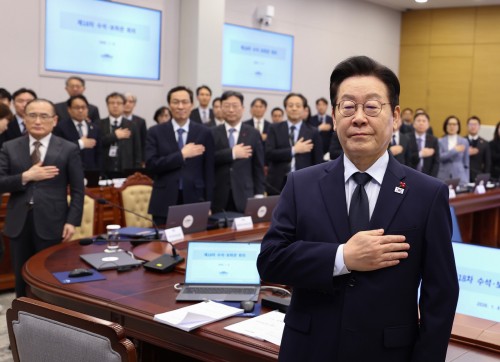 |
| President Lee Jae-myung salutes the national flag during a senior presidential aides’ meeting at Cheong Wa Dae on Jan. 8. / Yonhap |
President Lee Jae-myung said Thursday that South Korea must chart its own course through interest-first, pragmatic diplomacy, stressing that there are no permanent enemies or allies in today’s international order.
Speaking at his first meeting with senior presidential aides at Cheong Wa Dae, Lee said, “In a harsh global order where there are no eternal enemies, no eternal friends, and no eternal rules, the fate of the Republic of Korea depends on our ability to pursue national interests through practical diplomacy.”
He added that the government would continue to broaden cooperation with neighboring countries through “flexible and meticulous” diplomacy, while safeguarding national interests and strengthening state capacity to improve people’s lives.
Lee assessed his recent overseas trip as having laid a solid foundation for a full restoration of relations with China, saying it also created momentum to expand cooperation across economic and cultural sectors.
Observers say the remarks reaffirm Lee’s commitment to strategic flexibility—eschewing rigid pro-U.S. or pro-China alignments in favor of a national interest-centered approach—following progress on issues such as easing restrictions on Korean cultural content and addressing disputes over structures in the West Sea.
The president echoed the same message a day earlier at a luncheon with reporters in Shanghai, calling China “the world’s largest market with boundless potential” and questioning the logic of excluding it from South Korea’s diplomatic and economic calculus.
Lee also underscored the importance of securing competitiveness in future industries, particularly artificial intelligence. “The global race toward an AI-driven transformation has moved beyond individual companies to become a factor determining a nation’s destiny,” he said, urging faster efforts to secure talent, expand infrastructure, and strengthen global cooperation so AI can serve as the foundation for a qualitative transformation across society.
In addition, Lee emphasized the need to prepare steadily for an energy transition. Citing ongoing international turmoil over energy issues, he warned that how South Korea prepares for future energy sources and adapts to the transition could determine not only the country’s growth trajectory but its long-term fate.
#Lee Jae-myung #pragmatic diplomacy #national interest #Cheong Wa Dae #senior aides meeting
Copyright by Asiatoday
Most Read
-
1
Trump shares map on social media labeling Strait o..

-
2
Kia Sportage outperforms Mazda CX-5 in German auto..

-
3
Houthis launch successive attacks on Saudi airport..

-
4
U.S. deploys carrier, 10,000 more troops to Middle..

-
5
Trump rejects Iran's offer to open Strait of Hormu..

-
6
N. Korea conducts first swarm attack drill with dr..

-
7
U.S.-China summit falls short on substance as Trum..

PEOPLE





HEADLINE NEWS
- Seoul dismisses Ukraine's claim of 'S. Korean support for Russia' as "inaccurate and inappropriate"
- S. Korea, Japan race to develop nuclear-powered submarines
- Henri Kagan, Kenso Soai win Nobel Prize in Chemistry for uncovering how mol..
- Vance says Alaska LNG cooperation will move forward with Seoul's current or..

-
Address : In-Young Bldg., 34, Uisadang-daero 1-gil, Yeongdeungpo-gu, Seoul
Copyright by ASIATODAY CO., LTD. All rights resereved