



Deal uncertain on special prosecutor bills
Jan 09, 2026, 08:15 am


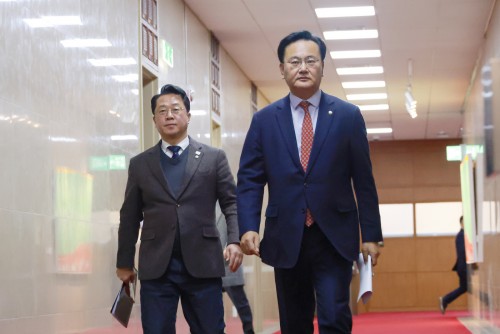 |
| People Power Party floor strategy chief Yoo Sang-beom (right) leaves the National Assembly Speaker’s office after meeting with Democratic Party acting floor leader Moon Jin-seok on Jan. 7 to discuss the next plenary session. At left is Democratic Party spokesperson Moon Geum-ju. / Yonhap |
With the National Assembly plenary session postponed by a week, attention is turning to whether the ruling and opposition parties can reach a compromise on the second comprehensive special prosecutor bill and the Unification Church special prosecutor bill—though prospects for agreement remain unclear.
According to political sources on Thursday, the Democratic Party of Korea and the People Power Party are intensifying strategic calculations ahead of the Jan. 15 plenary session. Expectations that talks might gain traction following the formation of the Democratic Party’s new floor leadership are tempered by continued sharp differences between the two sides.
The postponement reflects the ongoing stalemate over the Democratic Party’s push for a second round of comprehensive investigations. With the People Power Party signaling a filibuster, even a plenary session would have struggled to pass the bills within the December extraordinary session.
The Democratic Party aims to press ahead with the second comprehensive special prosecutor to probe allegations left unresolved by the previous three special probes, including accusations of insurrection and foreign exchange crimes involving former President Yoon Suk-yeol, as well as claims linked to notes attributed to former military intelligence chief Noh Sang-won.
The People Power Party flatly opposes launching another comprehensive probe, arguing it would cost roughly 15 billion won and delay work that should be handled by prosecutors. On the Unification Church bill, the Democratic Party is seeking to include the Shincheonji Church of Jesus among the investigation targets, a move the People Power Party rejects. The conservative party has also called for a parallel probe into Special Prosecutor Min Jung-gi amid allegations of selective investigations related to bribery.
On Wednesday, the bills were sent to a coordination subcommittee of the National Assembly’s Legislation and Judiciary Committee at the ruling party’s initiative. The Democratic Party plans to convene the subcommittee and the full committee on Jan. 12 to deliberate and vote. In the subcommittee, approval by at least four of six members allows a bill to be referred back to the standing committee for immediate action.
Behind-the-scenes negotiations are expected to continue until the bills are formally placed on the plenary agenda. With the Democratic Party set to elect a new floor leader on Jan. 11, both sides are likely to hold intensive talks up to the eve of the plenary session, party officials said.
Even so, many in political circles doubt a breakthrough before Jan. 15. A Democratic Party official said the party is accelerating the bills as its first legislative priority of the year, while the People Power Party is resisting the plenary session itself amid internal reorganization following a recent reform package. “Given these conditions,” the official said, “it will be difficult to find common ground before the 15th, and the process of agreement, scheduling, and passage is likely to come afterward.”
#National Assembly #special prosecutor bills #ruling and opposition parties #filibuster
Copyright by Asiatoday
Most Read
-
1
Trump shares map on social media labeling Strait o..

-
2
Kia Sportage outperforms Mazda CX-5 in German auto..

-
3
Houthis launch successive attacks on Saudi airport..

-
4
U.S. deploys carrier, 10,000 more troops to Middle..

-
5
Trump rejects Iran's offer to open Strait of Hormu..

-
6
N. Korea conducts first swarm attack drill with dr..

-
7
U.S.-China summit falls short on substance as Trum..

PEOPLE






HEADLINE NEWS
- Seoul dismisses Ukraine's claim of 'S. Korean support for Russia' as "inaccurate and inappropriate"
- S. Korea, Japan race to develop nuclear-powered submarines
- Henri Kagan, Kenso Soai win Nobel Prize in Chemistry for uncovering how mol..
- Vance says Alaska LNG cooperation will move forward with Seoul's current or..

-
Address : In-Young Bldg., 34, Uisadang-daero 1-gil, Yeongdeungpo-gu, Seoul
Copyright by ASIATODAY CO., LTD. All rights resereved