



Skepticism grows over People Power Party rebrand
Jan 09, 2026, 08:15 am


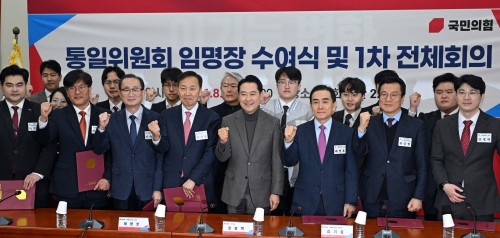 |
| People Power Party leader Jang Dong-hyuk poses for a photo with committee members at a Unification Committee appointment ceremony and plenary meeting at the National Assembly on Jan. 8. / Song Eui-ju |
As the People Power Party pushes ahead with plans to change its name, skepticism is mounting both inside and outside the party over whether the move represents real reform or merely a cosmetic rebranding.
Party leader Jang Dong-hyuk has put a party name change at the center of his reform agenda, moving quickly to project an image of renewal. Critics, however, question whether a new label alone can deliver the substantive change needed to restore public trust.
According to political sources on Thursday, the party aims to finalize a new name by early next month. The leadership is considering options such as commissioning experts to propose names or selecting one through a public contest.
Party officials insist the initiative goes beyond image management. Chief spokesperson Choi Bo-yoon told reporters that the effort is not simply about renaming the party, adding that a new body would be formed to review core values enshrined in party rules and bylaws.
Still, doubts persist. If carried out, the change would mark the party’s second renaming in six years, after it rebranded from the United Future Party to the People Power Party in 2020. Frequent name changes have fueled criticism that the party swaps signboards without delivering meaningful reform.
The conservative bloc has cycled through multiple names over the past three decades, including New Korea Party, Grand National Party, Saenuri Party, Liberty Korea Party, and United Future Party. Each change, critics say, failed to address deeper structural and ideological problems.
By contrast, the Democratic Party of Korea has maintained its current name since 2015, reinforcing perceptions of stability.
Analysts warn the latest rebranding push could amount to a short-term tactic to break out of stagnant approval ratings. They argue the party must first articulate what it seeks to reflect on and how it plans to change in concrete terms. A junior lawmakers’ group within the party has reportedly urged Jang to clearly distance the party from former President Yoon Suk-yeol and present specific measures to heal internal rifts.
Caution is also evident within party ranks. Lawmaker Park Chung-kwon said in a television interview that he does not favor frequent name changes, stressing that genuine transformation—not rebranding—must convince voters. “The real question is whether the party can function as the leading opposition and effectively check the Lee Jae-myung administration,” he said.
Another first-term lawmaker echoed the sentiment, saying it was unclear whether changing the party’s name was the right move. “You have to think about standing back up after being thoroughly broken,” the lawmaker said, adding that drawing stripes on a pumpkin does not make it a watermelon.
#People Power Party #party rebranding #name change #political reform #skepticism
Copyright by Asiatoday
Most Read
-
1
Trump shares map on social media labeling Strait o..

-
2
Kia Sportage outperforms Mazda CX-5 in German auto..

-
3
Houthis launch successive attacks on Saudi airport..

-
4
U.S. deploys carrier, 10,000 more troops to Middle..

-
5
Trump rejects Iran's offer to open Strait of Hormu..

-
6
N. Korea conducts first swarm attack drill with dr..

-
7
U.S.-China summit falls short on substance as Trum..

PEOPLE





HEADLINE NEWS
- Seoul dismisses Ukraine's claim of 'S. Korean support for Russia' as "inaccurate and inappropriate"
- S. Korea, Japan race to develop nuclear-powered submarines
- Henri Kagan, Kenso Soai win Nobel Prize in Chemistry for uncovering how mol..
- Vance says Alaska LNG cooperation will move forward with Seoul's current or..

-
Address : In-Young Bldg., 34, Uisadang-daero 1-gil, Yeongdeungpo-gu, Seoul
Copyright by ASIATODAY CO., LTD. All rights resereved