



June by-elections shape up as mini general election
Jan 09, 2026, 08:15 am


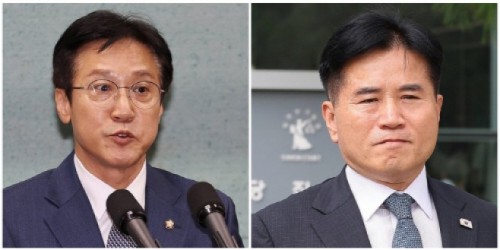 |
| Democratic Party lawmakers Shin Young-dae (left) and Lee Byeong-jin. / Yonhap |
South Korea’s June parliamentary by-elections are shaping up to be a de facto “mini general election” after two ruling party lawmakers lost their seats on Thursday following Supreme Court rulings.
Lee Byeong-jin of Pyeongtaek-eul in Gyeonggi Province and Shin Young-dae of Gunsan–Gimje–Buan Gap in North Jeolla Province were stripped of their Assembly memberships after the Supreme Court of Korea finalized guilty verdicts in election law cases.
With the two seats vacated, the number of confirmed districts set to hold by-elections on June 3—alongside the 9th nationwide local elections—has risen to four, following Incheon Gyeyang-eul and South Chungcheong Province’s Asan-eul. Factoring in other pending court cases and possible resignations by incumbent lawmakers seeking local executive posts, as many as around 10 seats or more could be contested.
The Supreme Court’s First Division upheld a lower court ruling that fined Lee 7 million won for violating the Public Official Election Act, citing underreporting and omissions in asset disclosures during the last general election. Under the law, elected officials automatically forfeit their seats if fined 1 million won or more for election law violations.
On the same day, Shin also lost his seat after the court upheld a suspended prison sentence for his campaign office chief, who was convicted of manipulating opinion polls during the party primary. Under Article 265 of the election law, a lawmaker’s election is nullified if a campaign manager receives a prison sentence or a fine of 3 million won or more.
As a result, four districts are now confirmed for by-elections: Gyeyang-eul, which became vacant after President Lee Jae-myung ran for office; Asan-eul, vacated following the appointment of Kang Hoon-sik as presidential chief of staff; and the newly added Pyeongtaek-eul and Gunsan–Gimje–Buan Gap.
Further legal risks remain. The Supreme Court is still reviewing a case involving Yang Moon-seok, while appeals are under way for Song Ok-joo and Heo Jong-sik, both of whom received rulings that would invalidate their elections at first instance. Any adverse outcomes could further expand the number of by-elections.
The scale could grow even larger if incumbent lawmakers step down to run in local elections. Under election law, lawmakers must resign by May 4 to contest local races, but to trigger simultaneous by-elections on June 3, resignations must be finalized by April 30.
Within the Democratic Party of Korea, several incumbents are being mentioned as potential candidates for mayoral and gubernatorial races, while senior figures from the People Power Party are also rumored to be weighing bids for local executive posts.
For the ruling Democratic Party, the expanding slate of by-elections is an unwelcome burden. Having lost two seats in a single day, the party now faces the challenge of crafting nomination strategies while simultaneously preparing for both nationwide local elections and a large-scale parliamentary by-election—raising the political stakes of June’s vote considerably.
#June by-election #South Korea politics #Democratic Party #Supreme Court ruling
Copyright by Asiatoday
Most Read
-
1
Trump shares map on social media labeling Strait o..

-
2
Kia Sportage outperforms Mazda CX-5 in German auto..

-
3
Houthis launch successive attacks on Saudi airport..

-
4
U.S. deploys carrier, 10,000 more troops to Middle..

-
5
Trump rejects Iran's offer to open Strait of Hormu..

-
6
N. Korea conducts first swarm attack drill with dr..

-
7
U.S.-China summit falls short on substance as Trum..

PEOPLE





HEADLINE NEWS
- Seoul dismisses Ukraine's claim of 'S. Korean support for Russia' as "inaccurate and inappropriate"
- S. Korea, Japan race to develop nuclear-powered submarines
- Henri Kagan, Kenso Soai win Nobel Prize in Chemistry for uncovering how mol..
- Vance says Alaska LNG cooperation will move forward with Seoul's current or..

-
Address : In-Young Bldg., 34, Uisadang-daero 1-gil, Yeongdeungpo-gu, Seoul
Copyright by ASIATODAY CO., LTD. All rights resereved