



Selfie diplomacy brings Seoul and Beijing closer, but real test begins
Jan 08, 2026, 08:08 am


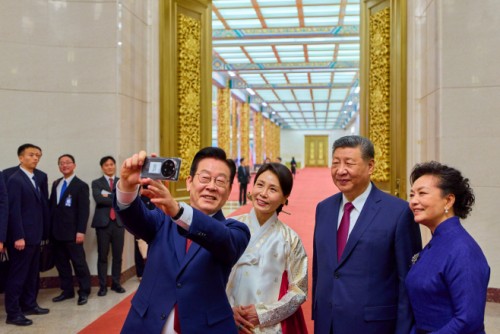 |
| President Lee Jae-myung and his spouse pose for a selfie with Chinese President Xi Jinping and his spouse after a state banquet at the Great Hall of the People in Beijing on Jan. 5. The photo was taken with a Xiaomi smartphone that President Xi had gifted to President Lee during the Gyeongju summit. / Yonhap |
Lee Jae-myung returned home Wednesday after completing a four-day state visit to China, a trip widely seen as restoring South Korea–China relations to a normal track after years of strain following the 2016 deployment of the THAAD missile defense system.
Lee and Xi Jinping met for the first time in two months after last year’s APEC summit and drew attention by taking a close-up selfie with a Xiaomi smartphone equipped with a Samsung Display panel — a gesture interpreted as a signal of renewed “strategic cooperative partnership.”
At their summit on Jan. 5, Lee said the meeting would serve as “an important turning point to make 2026 the first year of a full restoration of South Korea–China relations.” Xi responded that China hopes to firmly steer ties toward friendship and cooperation and place the strategic partnership on a “sound and stable track” based on mutual benefit.
Seoul raised a number of long-standing issues, including peace on the Korean Peninsula, the possible lifting of China’s informal ban on Korean cultural content, and disputes over Chinese structures and illegal fishing in the West Sea. Xi’s remark that “three feet of ice does not melt in a day, and ripe fruit falls naturally” was widely read as hinting at a gradual easing of restrictions on cultural exchanges.
On maritime issues, the two sides agreed to continue “constructive consultations” on Chinese structures in the West Sea and to hold a vice-ministerial-level meeting within the year to work toward defining maritime boundaries — one of the visit’s more concrete outcomes.
Still, the absence of a joint statement despite the state visit has fueled concerns that agreements may remain largely declaratory. National Security Adviser Wi Sung-lac said the leaders reaffirmed the importance of resuming dialogue with North Korea and China’s willingness to play a constructive role in peace and stability on the peninsula. Notably, however, China’s official readout did not mention the Korean Peninsula, and Seoul’s briefing avoided explicit reference to North Korea’s nuclear issue.
Xi’s comment that countries should “stand firmly on the right side of history and make correct strategic choices” was interpreted by some analysts as pressure on Seoul amid intensifying U.S.-China and China-Japan rivalries. As a result, observers say the real test of Lee’s national-interest-centered pragmatic diplomacy begins now, after the optics of the summit have faded.
Lee is also reportedly planning a meeting with Japanese Prime Minister Sanae Takaichi, adding to questions about how Seoul will position itself amid shifting regional dynamics.
During the visit, Lee met not only Xi but also Premier Li Qiang, National People’s Congress Standing Committee Chairman Zhao Leji, and Shanghai Party Secretary Chen Jining, who is widely mentioned as a future top leader. Analysts see the broad range of high-level meetings as evidence of Beijing’s strong diplomatic courtesy and a sign of warming ties. China’s People’s Daily highlighted the summit prominently on its front page the following day.
Speaking at a luncheon with reporters in Shanghai, Lee said the summit focused on rebuilding trust between the two governments and expanding goodwill and mutual understanding between their peoples, adding that “very meaningful progress” had been made in that regard.
#Lee Jae-myung #Xi Jinping #South Korea–China relations #state visit to China
Copyright by Asiatoday
Most Read
-
1
Trump shares map on social media labeling Strait o..

-
2
Kia Sportage outperforms Mazda CX-5 in German auto..

-
3
Houthis launch successive attacks on Saudi airport..

-
4
U.S. deploys carrier, 10,000 more troops to Middle..

-
5
Trump rejects Iran's offer to open Strait of Hormu..

-
6
N. Korea conducts first swarm attack drill with dr..

-
7
U.S.-China summit falls short on substance as Trum..

PEOPLE



HEADLINE NEWS
- Seoul dismisses Ukraine's claim of 'S. Korean support for Russia' as "inaccurate and inappropriate"
- S. Korea, Japan race to develop nuclear-powered submarines
- Henri Kagan, Kenso Soai win Nobel Prize in Chemistry for uncovering how mol..
- Vance says Alaska LNG cooperation will move forward with Seoul's current or..

-
Address : In-Young Bldg., 34, Uisadang-daero 1-gil, Yeongdeungpo-gu, Seoul
Copyright by ASIATODAY CO., LTD. All rights resereved