



Lee urges review of fees on returned US military sites
Dec 19, 2025, 09:40 am


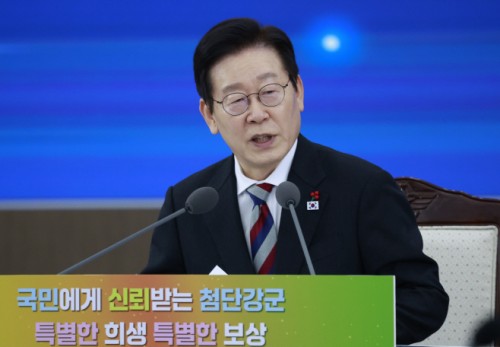 |
| President Lee Jae-myung speaks during a work briefing by the Ministry of National Defense and the Ministry of Patriots and Veterans Affairs at the defense ministry headquarters in Yongsan, Seoul, on December 18. / Source: Yonhap News |
President Lee Jae-myung on December 18 called on the defense ministry to devise ways for local governments to more actively utilize land returned by the US military in northern Gyeonggi Province, questioning whether it is necessary to charge local authorities 20% of the land value.
Speaking during a work briefing by the Ministry of National Defense and the Ministry of Patriots and Veterans Affairs at the defense ministry in Yongsan, Lee pointed to large tracts of returned US military sites that remain unused. He noted that local governments seeking to use the land for public purposes such as roads and parks receive 80% support from the central government. “Is it really necessary to collect the remaining 20%?” he asked.
Lee said US military bases had occupied local areas for decades, hindering regional development and causing long-term harm. “These regions have borne special sacrifices for a long time,” he said, adding that calls to further reduce the burden on local governments were understandable. He urged Defense Minister Ahn Gyu-back to give the matter deeper consideration.
In response, Ahn said the argument might appear reasonable from the public’s perspective, since both central and local governments ultimately serve citizens, but warned that fully waiving the cost could encourage laxity among local governments. He added that such a move would also require revisions to multiple laws governing land use, including those related to railway sites.
Lee pressed the issue again, asking the ministry to narrowly focus its review on returned US military sites and to explore more proactive solutions.
He also proposed alternative approaches for idle sites returned by the US military, including establishing special purpose companies (SPCs) or pursuing direct development by the central government.
During the briefing, Lee stressed the need to strengthen constitutional education for service members, saying there is sometimes confusion over whether their loyalty should be to the president or to the state and the people. Referring to the recent martial law crisis, he said many service members had suffered unintended harm because it can be difficult for soldiers to judge whether an order is constitutional and legitimate. “They need to be equipped with the capacity to make that judgment,” he said.
Lee asked about the current state of constitutional education in the South Korean military and noted that the US military is known to provide systematic instruction in constitutional principles. He said South Korea should also adopt a more structured and rigorous approach.
The president also instructed officials to raise the issue of recovering and repatriating the remains of independence activists as a pre-agenda item for future South Korea–China summits. After receiving a briefing from Patriots and Veterans Affairs Minister Kwon Oh-eul on efforts to repatriate the remains of Ahn Jung-geun, Lee said consultations with China would be crucial and asked both the ministry and the presidential office to give the matter special attention.
#Lee Jae-myung #returned US military bases #land fees #local governments #Ministry of National Defense
Copyright by Asiatoday
Most Read
-
1
Trump shares map on social media labeling Strait o..

-
2
Kia Sportage outperforms Mazda CX-5 in German auto..

-
3
Houthis launch successive attacks on Saudi airport..

-
4
U.S. deploys carrier, 10,000 more troops to Middle..

-
5
Trump rejects Iran's offer to open Strait of Hormu..

-
6
N. Korea conducts first swarm attack drill with dr..

-
7
U.S.-China summit falls short on substance as Trum..

PEOPLE





HEADLINE NEWS
- Seoul dismisses Ukraine's claim of 'S. Korean support for Russia' as "inaccurate and inappropriate"
- S. Korea, Japan race to develop nuclear-powered submarines
- Henri Kagan, Kenso Soai win Nobel Prize in Chemistry for uncovering how mol..
- Vance says Alaska LNG cooperation will move forward with Seoul's current or..

-
Address : In-Young Bldg., 34, Uisadang-daero 1-gil, Yeongdeungpo-gu, Seoul
Copyright by ASIATODAY CO., LTD. All rights resereved