



U.S. names deterrence, denuclearization, Indo-Pacific as alliance pillars
Dec 04, 2025, 10:44 am


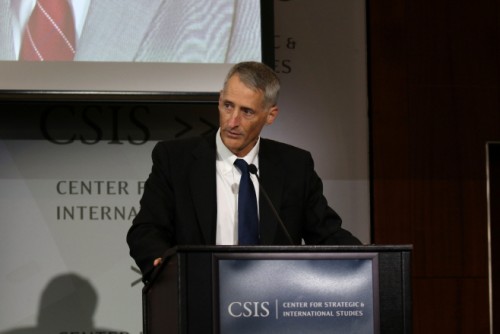 |
| Jonathan Fritz, U.S. Deputy Assistant Secretary of State, delivers a keynote address at the Korea–U.S. Strategic Forum hosted by CSIS and the Korea Foundation in Washington, D.C., on December 3. / Photo by Hah Man-joo, Washington Correspondent |
Jonathan Fritz, senior deputy assistant secretary at the U.S. State Department, on December 3 identified extended deterrence, North Korea’s complete denuclearization, and Indo-Pacific regional cooperation as the three central pillars of the Korea–U.S. alliance.
Speaking at the Korea–U.S. Strategic Forum jointly hosted by the Korea Foundation and the Center for Strategic and International Studies (CSIS), Fritz said the alliance today rests on “a foundation stronger than ever, with clear continuity across three core areas.”
He reaffirmed Washington’s commitment to the nuclear umbrella, saying the United States’ extended deterrence pledge “remains ironclad.”
On North Korea, Fritz stressed that Washington and Seoul are “fully aligned” in urging Pyongyang to give up its nuclear and missile programs. “Both President Donald Trump and President Lee Jae-myung have supported meaningful dialogue with North Korea and have pressed the regime to comply with its international obligations, including abandoning its WMD and ballistic missile programs,” he said.
Fritz underscored that the United States will continue close coordination with South Korea and partners across the region to uphold international maritime law and safeguard peace and stability in the Taiwan Strait, the South China Sea, and other parts of the Indo-Pacific.
He highlighted South Korea’s role in key strategic industries, citing shipbuilding as a notable example. “We are coordinating with the Korean government more closely than ever on issues affecting both the Korean Peninsula and the broader Indo-Pacific,” he said.
Fritz also noted that President Trump has expressed support for South Korea’s plan to build conventionally armed nuclear-powered submarines, calling it a “clear example of bilateral cooperation that strengthens our collective capability against regional threats.”
Reflecting on follow-up steps to the October Korea–U.S. summit, he said the Joint Fact Sheet issued afterward outlines eight priority areas: revitalizing core industries, stabilizing foreign exchange markets, strengthening commercial ties, expanding reciprocal trade, safeguarding economic prosperity, modernizing the alliance, enhancing cooperation on Korean Peninsula and regional issues, and advancing maritime and civil nuclear cooperation.
“South Korea is absolutely central to the president’s pledge to reindustrialize America,” Fritz said, emphasizing the need for continued Korean investment in shipbuilding, energy, semiconductors, pharmaceuticals, critical minerals, artificial intelligence, and quantum technologies.
#Extended deterrence #North Korea denuclearization #Indo-Pacific cooperation #Korea–U.S. strategic industries
Copyright by Asiatoday
Most Read
-
1
Trump shares map on social media labeling Strait o..

-
2
Kia Sportage outperforms Mazda CX-5 in German auto..

-
3
Houthis launch successive attacks on Saudi airport..

-
4
U.S. deploys carrier, 10,000 more troops to Middle..

-
5
Trump rejects Iran's offer to open Strait of Hormu..

-
6
N. Korea conducts first swarm attack drill with dr..

-
7
U.S.-China summit falls short on substance as Trum..

PEOPLE






HEADLINE NEWS
- Seoul dismisses Ukraine's claim of 'S. Korean support for Russia' as "inaccurate and inappropriate"
- S. Korea, Japan race to develop nuclear-powered submarines
- Henri Kagan, Kenso Soai win Nobel Prize in Chemistry for uncovering how mol..
- Vance says Alaska LNG cooperation will move forward with Seoul's current or..

-
Address : In-Young Bldg., 34, Uisadang-daero 1-gil, Yeongdeungpo-gu, Seoul
Copyright by ASIATODAY CO., LTD. All rights resereved