



Korea’s seniors work to 73, on scant pensions
Nov 26, 2025, 09:56 am


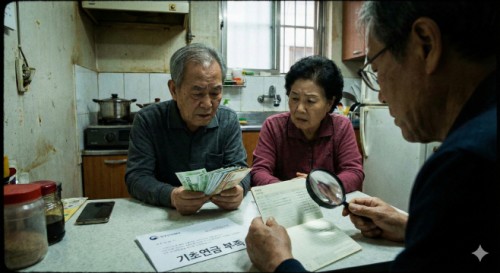 |
| Elderly Koreans work at a local market in Seoul, highlighting how many seniors remain in the labor force well past retirement age to make ends meet. / Source: Gemini image |
Korean seniors are working longer and more than their peers in any other OECD country, largely to cover basic living expenses, a new report has found.
According to a study titled “The National Pension and Labor Supply of Older People” released on November 26 by Oh Yu-jin, a researcher at the National Pension Research Institute, Korea officially became a super-aged society in 2025, with people aged 65 and older making up 20.3 percent of the population.
In particular, the employment rate among Koreans aged 65 and older stood at 37.3 percent in 2023, far above the OECD average of 13.6 percent and the highest among member countries. The rate is higher even than that of Japan, which is already a super-aged society, at 25.3 percent.
The survey found that older Koreans hope to work until an average age of 73.4.
The most common reason for wanting to continue working was “to cover living expenses,” cited by 54.4 percent of respondents. Far fewer pointed to voluntary factors such as “the joy of working” (36.1 percent) or “to avoid boredom” (4.0 percent).
The report identifies the low level of public pension benefits as the fundamental driver behind this survival-driven labor. As of 2024, the average monthly National Pension benefit was about 660,000 won, less than half the minimum cost of living for a single-person household (1.34 million won per month). In other words, unlike in many Western countries, Koreans cannot simply retire once they start receiving their pension.
The report also points to a structural problem facing Korean seniors: an income “gap decade.” While the statutory retirement age is 60, the average age at which workers leave their main job is just 52.9 as of 2025.
At the same time, the eligibility age for receiving the National Pension is being pushed back to between 63 and 65, forcing many to endure at least a 10-year period with little or no stable income after leaving their primary job.
The report notes that raising the pension eligibility age may help stabilize the system’s finances, but in practice becomes a powerful factor pushing older Koreans back into the labor market.
The contradictions in the pension system also come under scrutiny. While the government stresses the need to expand employment among older workers, it still maintains an earnings test that can reduce old-age pension benefits by up to 50 percent if a recipient’s income exceeds a certain threshold—3.08 million won per month in 2025. Critics argue this reinforces the perception that “working hurts you” financially.
However, the report says the impact on overall elderly employment is limited, as the earnings test mainly affects a relatively small group of high-income earners. For most seniors, the pressing need to earn an income outweighs the risk of benefit reductions.
By contrast, the deferred pension option—under which benefits increase by 7.2 percent for each year the recipient postpones the start of payments—is highlighted as a mechanism that encourages older people to stay in the workforce. When health and job opportunities allow, some choose to delay retirement in order to receive higher benefits later.
Oh noted that, unlike earlier overseas studies which found that public pensions reduce labor among older people, recent Korean research shows the National Pension has little to no impact on labor supply. The benefits are simply too low to significantly influence retirement decisions.
In the end, the report concludes, Korean seniors “have to work even if they have a pension, and they have to work in order to hold out until their pension starts.”
The study argues that, especially in light of falling birthrates and looming labor shortages, Korea needs institutional reforms to make better use of older workers in a stable and sustainable way.
Most Read
-
1
Celltrion’s Omlyclo gains ground in major European..

-
2
Trump demands rates fall below 1% as Fed hikes for..

-
3
Hyundai Motor Group breaks ground on integrated st..

-
4
U.S. strikes 3 Iranian oil tankers, Iran vows reta..

-
5
Trump makes $1 trillion bet ahead of midterm elect..

-
6
Iran resumes ballistic missile production, assembl..

-
7
Samsung Electronics, Mistral AI to jointly develop..

PEOPLE






-
Address : In-Young Bldg., 34, Uisadang-daero 1-gil, Yeongdeungpo-gu, Seoul
Copyright by ASIATODAY CO., LTD. All rights resereved