



Trump urges Putin to halt military aggression across Europe
Nov 27, 2026, 04:34 pm


 |
| /Donald Trump |
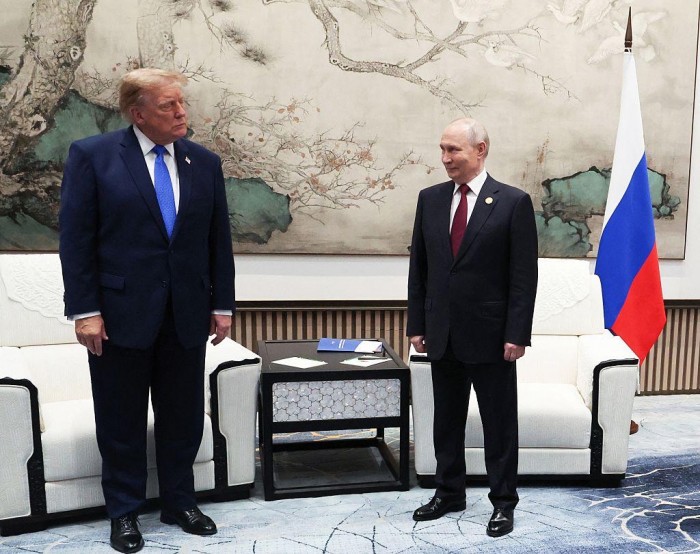
U.S. President Donald Trump said he had urged Russian President Vladimir Putin to halt military aggression across Europe. His remarks are seen as a message to Russia not to extend its military pressure across Europe as he seeks a swift agreement to end the war in Ukraine.
According to Reuters on November 27 (local time), Trump said in a post on his social media platform Truth Social the previous day that he had asked Putin during their talks in China to end Russian military aggression against territories throughout Europe.
Trump expressed hope that Russia and Ukraine would reach an agreement quickly, describing the situation in which thousands of people are dying every month as a “total bloodbath.”
The remarks followed a U.S.-Russia summit held on the sidelines of the Asia-Pacific Economic Cooperation (APEC) summit in Shenzhen, China, on November 19. Trump has expressed hope that direct dialogue with Putin could help resolve the war in Ukraine and European security issues.
However, it remains unclear what exactly Trump meant by military aggression across Europe. His remarks could be interpreted as encompassing not only military operations on the Ukrainian front but also Russia's military pressure and provocations against neighboring countries.
Zelenskyy warns Russia is preparing large-scale air attack
Despite hopes for an end to the war, tensions persist on the battlefield in Ukraine. According to reports by Al Jazeera and Reuters, Ukrainian President Volodymyr Zelenskyy said in a video address on the evening of November 26 that Ukraine had obtained intelligence indicating that Russia was preparing another large-scale air attack in the coming days.
Issuing his second warning this week about the possibility of a major Russian attack, Zelenskyy urged citizens to heed missile attack alerts. He also said Ukraine would retaliate if Russian attacks continued.
Trump identified the animosity between Putin and Zelenskyy as the biggest obstacle to peace negotiations. He claimed that the two leaders deeply disliked each other and that their relationship was making it difficult to reach an agreement.
However, prospects for concrete agreements on key issues in the war, including territorial disputes, security guarantees and the extent of Russian troop withdrawals, remain uncertain. It remains to be seen whether improving personal relations between the leaders alone will be enough to end the war.
Putin's potential G20 attendance poses another diplomatic test
The Group of 20 (G20) summit, scheduled to take place in Florida, U.S., on December 14 and 15, is also expected to be a factor in U.S.-Russia relations.
Trump said he would welcome Putin's attendance but was unsure whether the Russian president would actually attend. The Kremlin also said on November 26 that Putin's attendance had yet to be decided.
Tensions between Russia and Europe also persist. Poland recently accused Russia of deliberately violating its airspace, while Estonia linked a recent arson incident to Russia's military intelligence service.
As the Trump administration expands direct dialogue with Russia, European allies are questioning whether the U.S. is exerting sufficient pressure on Moscow. The extent to which Ukraine's security and European countries' interests are reflected in peace negotiations is expected to become a central issue in diplomatic efforts going forward.
Cheon Hyun-bin
#Trump #Putin #Europe #Russia #Drone
Copyright by Asiatoday
Most Read
-
1
China President Xi's Keynote Speech at the APEC C..

-
2
Iran resumes attacks after two months, targeting U..

-
3
Russian warship sinks in suspected drone attack at..

-
4
Inside Kylin Villa, the symbol of China's reform h..

-
5
Trump, Xi, Putin call for security cooperation at..

-
6
Trump, Putin, Zelenskyy may hold peace talks at G2..

-
7
Trump, Xi pledge cooperation on Hormuz, Iran nucle..

PEOPLE






-
Address : In-Young Bldg., 34, Uisadang-daero 1-gil, Yeongdeungpo-gu, Seoul
Copyright by ASIATODAY CO., LTD. All rights resereved