



SpaceX-Tesla $3.5 trillion merger talks advance
Nov 27, 2026, 09:05 am


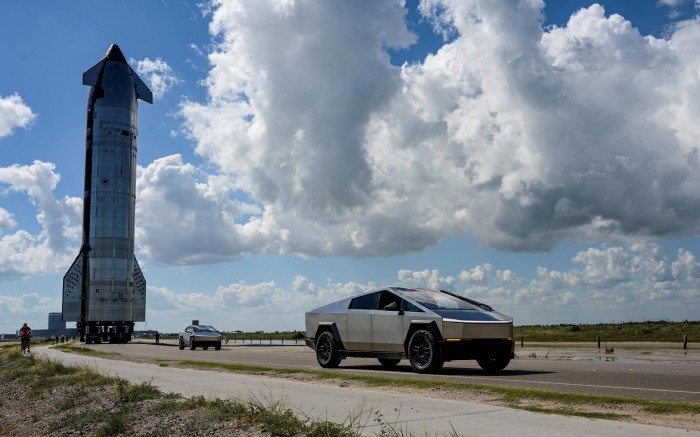 |
| A Tesla Cybertruck drives past Launch Pad 2, where Starship 41 and Super Heavy V3 Booster 21 are stationed, at SpaceX's launch site in Starbase, Texas, on September 27 (local time). SpaceX is preparing for its 14th test flight. / Reuters-Yonhap |
Negotiations over a massive $3.5 trillion (approximately 4,700 trillion won) merger between Elon Musk-led SpaceX and Tesla are gathering momentum. With the appointment of directors and financial advisers to handle the negotiations, the share exchange ratio and Musk's control over the combined company have emerged as key issues.
According to the Financial Times (FT) and other media outlets on November 25 (local time), the two companies have appointed five directors to their special committees overseeing the merger negotiations and are discussing specific merger terms. SpaceX is represented by Roelof Botha and Randy Glein, while Tesla is represented by board chair Robyn Denholm, Kathleen Wilson-Thompson and Jack Hartung. Musk has been excluded from formal negotiations due to conflicts of interest arising from his position as CEO of both companies. Morgan Stanley and Goldman Sachs are serving as financial advisers to SpaceX, while Evercore is advising Tesla. They are assessing the companies' valuations, business overlaps and potential merger synergies, which will form the basis for negotiations on detailed terms, including the share exchange ratio, management composition and corporate governance.
The merger structure currently under discussion is an all-stock merger rather than a cash acquisition. Shareholders of both companies would exchange their existing shares for shares in the combined company, although the specific exchange ratio and allocation of ownership stakes among shareholders have yet to be determined.
The biggest question is how much of a premium Tesla shareholders will receive in the merger. On October 21, Reuters reported, citing Wall Street investors and analysts, that Tesla shareholders might need to be offered a premium of 20 to 35 percent. The argument is that Tesla shareholders should be compensated for the value of Tesla as an independent company, given that they would exchange their shares for those of SpaceX, which is controlled by Musk. Others, however, suggest that the substantial overlap between the two companies' shareholder bases could limit the premium.
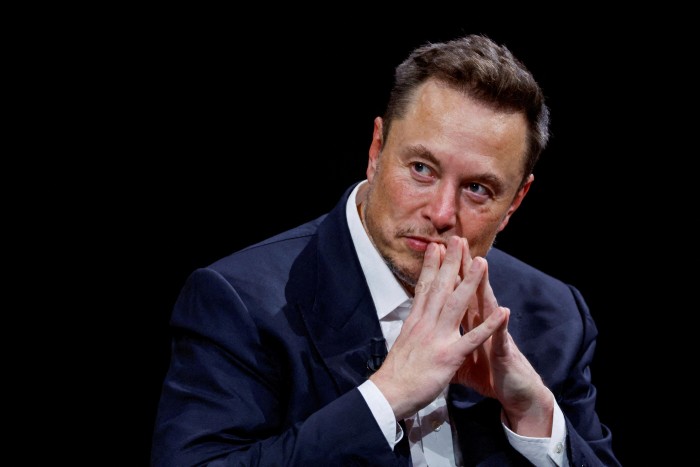 |
| Elon Musk, CEO of Tesla and SpaceX, speaks at the VivaTech event in Paris, France, on October 20 (local time). / Reuters-Yonhap |
Mega-merger to unite EVs, rockets, satellite communications and AI, with ambitions extending to space infrastructure
The share exchange ratio is another key variable. British investment bank Barclays floated an illustrative exchange ratio of 0.7 SpaceX shares for each Tesla share. One analysis suggested that under this ratio, Musk could hold approximately 58 percent of the voting rights in the combined company. However, this is merely a hypothetical scenario put forward by the investment community. The actual exchange ratio has yet to be agreed upon in negotiations. Reuters reported that some investors' analyses point to a potential exchange ratio of around 0.6 SpaceX shares for each Tesla share.
Musk currently holds approximately 85 percent of the voting rights in SpaceX and around 20 percent in Tesla. If the merger goes through, Musk could gain majority voting control of the combined company.
However, the merger requires approval from Tesla shareholders. Musk previously said that approval from holders of a majority of Tesla's outstanding shares would be required. As shares not voted could effectively count as votes against the merger, securing shareholder approval is considered a major hurdle.
The proposed merger seeks to expand the companies' business into the broader artificial intelligence (AI) industry by combining Tesla's autonomous driving and humanoid robot technologies with SpaceX's rocket launch services, Starlink satellite communications and space infrastructure. If space-based data centers and computing infrastructure are also integrated, the merger could create a technology giant that transcends the boundaries of the automotive and aerospace industries.
However, regulatory and conflict-of-interest issues must be resolved before the merger can be finalized. While SpaceX is a major contractor for the U.S. Department of Defense and the National Aeronautics and Space Administration (NASA), Tesla operates its Shanghai factory in China as a key production hub. National security reviews and regulations concerning its Chinese operations are therefore considered potential variables.
Conflicts of interest involving Musk also led to shareholder litigation when Tesla acquired SolarCity in 2016. The fairness of the merger terms and the independence of the decision-making process are expected to come under close scrutiny in the proposed transaction as well.
Cheon Hyun-bin
Most Read
-
1
China President Xi's Keynote Speech at the APEC C..

-
2
Iran resumes attacks after two months, targeting U..

-
3
Russian warship sinks in suspected drone attack at..

-
4
Inside Kylin Villa, the symbol of China's reform h..

-
5
Trump, Xi, Putin call for security cooperation at..

-
6
Trump, Putin, Zelenskyy may hold peace talks at G2..

-
7
Trump, Xi pledge cooperation on Hormuz, Iran nucle..

PEOPLE







-
Address : In-Young Bldg., 34, Uisadang-daero 1-gil, Yeongdeungpo-gu, Seoul
Copyright by ASIATODAY CO., LTD. All rights resereved