



Japan's IT staffing shortage raises concerns over municipal cybersecurity preparedness
Nov 27, 2026, 09:21 am


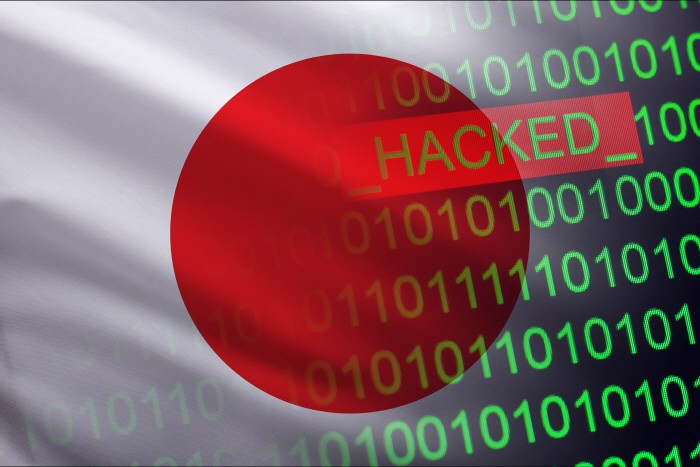 |
| An image of the word “HACKED” and digital code superimposed on the Japanese flag. A survey found that 198 Japanese municipalities have one or no dedicated information technology (IT) staff members, raising concerns about potential gaps in their ability to respond to cyberattacks. / Getty Images Bank |
In a small city in Japan's Ehime Prefecture, only one employee is responsible for managing information systems. Whenever a system failure occurs, he must deal with it alone, whether on a weekday or a holiday. He worries about who would take over his duties if a cyberattack occurred in his absence. Although he hopes more specialists will be hired, additional staffing is unlikely given that even private companies struggle to find qualified personnel.
As many as 198 Japanese municipalities have only one or no dedicated information systems staff members. Citing a survey by the Ministry of Internal Affairs and Communications, the Yomiuri Shimbun reported on November 27 that such municipalities accounted for more than 10 percent of the nationwide total as of April last year. While public services increasingly rely on computer networks, information system management in some municipalities depends on the experience and availability of a single employee.
When there is only one dedicated IT employee, that person must handle not only routine system management and inquiries from residents but also security checks. In the event of an incident, the employee must simultaneously assess the extent of the damage, block external access and restore services. In municipalities without dedicated IT personnel, employees responsible for other duties must also manage information systems. For these reasons, experts regard having a “one-person IT department” as a crisis management risk.
Cyberthreats targeting Japan's government and financial services have continued to emerge recently. On November 20, Japan's Digital Agency announced that it had detected unauthorized external access to a shared file-sharing service used by government agencies. The agency suspended the service and launched an investigation, citing the possibility that some files had been leaked.
Seven Bank also detected signs of unauthorized access to its residence card submission website and account closure request website on November 9 and suspended both sites. The bank is investigating the possibility that up to approximately 150 residence card records may have been leaked. Seven Bank said its major services, including automated teller machines (ATMs) and online banking, were unaffected.
The Japanese National Tax Agency's online tax filing service, e-Tax, was also temporarily suspended for inspection on November 4 after suspicious network activity was detected. The agency resumed the service after confirming its security and said no taxpayer information had been leaked. The suspicious activity has not been confirmed to have resulted from a cyberattack.
 |
| Japan's Digital Agency announced on November 20 that it had detected unauthorized external access to a shared file-sharing service used by government agencies. The photo shows Kioi Tower in Tokyo's Chiyoda Ward, which houses the Digital Agency. / Yonhap News Agency |
2.44 million people trained, but workforce deployment remains a challenge
Personnel shortages are not limited to local governments. According to the Ministry of Internal Affairs and Communications' 2026 White Paper on Information and Communications in Japan, a multiple-response survey asking companies about barriers to digitalization found that personnel shortages were the most frequently cited obstacle in Japan. The figure stood at 39.4 percent, more than twice the 18.4 percent recorded in the U.S. This indicates that even when companies seek to introduce new systems and change their working practices, they lack personnel dedicated to carrying out such initiatives.
Convenience store operator Lawson is looking to employee training for a solution. It teaches existing employees, including sales and administrative staff, how to use generative artificial intelligence (AI) and develop simple applications to improve their day-to-day work. Since Lawson introduced its in-house “citizen developer” certification in 2022, the cumulative number of employees certified has reached approximately 1,900. They have reportedly developed a system that automatically delivers product information to stores and an attendance management app. This illustrates how frontline employees can take on more tasks to improve their own work when assigning professional developers to every task is difficult.
The Japanese government has already exceeded its workforce training target. It set a goal of training 2.3 million digital professionals between fiscal 2022 and fiscal 2026, but the cumulative total had reached approximately 2.44 million by the end of fiscal 2025. However, receiving training does not necessarily mean that these individuals are being placed in positions where they are needed at municipalities and businesses. The Digital Agency also noted that the actual outcomes achieved by those who received training had not been sufficiently assessed, adding that future efforts should evaluate not only the number of people trained but also their competencies and actual workplace demand.
The skills required are also changing. Personnel are needed not only to maintain existing systems but also to address newly discovered security vulnerabilities, monitor risks associated with services operated by external vendors and apply AI in the workplace. Earlier this month, the Japanese government's cybersecurity authorities warned that their analysis of a series of unauthorized access incidents had revealed shortcomings in basic security measures, including website configuration errors and the use of outdated software.
The success of the new digital workforce development targets currently under discussion by the Japanese government cannot be measured solely by the number of people trained. More important, observers point out, is whether public services can continue when the sole dedicated IT employee at a municipality takes leave or changes jobs, and whether a system is in place to respond to incidents. Experts say that as cyberattacks disrupt day-to-day operations, Japan's challenge is to deploy trained personnel where they are needed and distribute responsibilities that currently fall on a single individual.
Choi Young-jae
Most Read
-
1
China President Xi's Keynote Speech at the APEC C..

-
2
Iran resumes attacks after two months, targeting U..

-
3
Russian warship sinks in suspected drone attack at..

-
4
Inside Kylin Villa, the symbol of China's reform h..

-
5
Trump, Xi, Putin call for security cooperation at..

-
6
Trump, Putin, Zelenskyy may hold peace talks at G2..

-
7
Trump, Xi pledge cooperation on Hormuz, Iran nucle..

PEOPLE







-
Address : In-Young Bldg., 34, Uisadang-daero 1-gil, Yeongdeungpo-gu, Seoul
Copyright by ASIATODAY CO., LTD. All rights resereved