



Korean businesses seek government support as U.S. and EU trade barriers rise
Nov 27, 2026, 02:06 pm


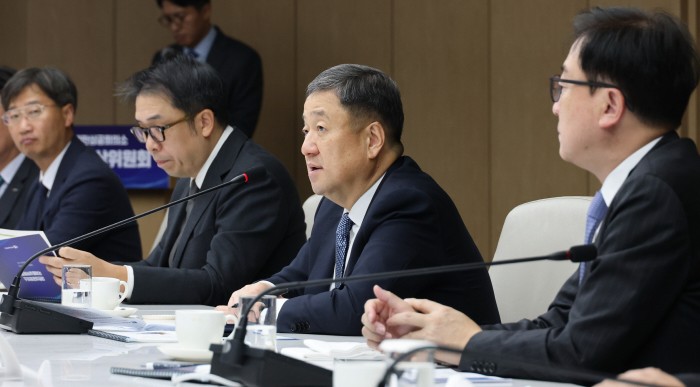 |
| Lee Kye-in, chairman of the Korea Chamber of Commerce and Industry's International Trade Committee and CEO of POSCO International, delivers opening remarks. / Korea Chamber of Commerce and Industry |
Uncertainty surrounding South Korean companies' exports and overseas investments is growing as protectionist policies persist following the U.S. midterm elections. The U.S. is moving to impose new tariffs, citing excess manufacturing capacity, while the European Union (EU) is also raising trade barriers to protect its domestic industries. Not only the semiconductor and automotive industries but also power equipment manufacturers expanding their production facilities in the U.S. are closely monitoring changes in trade policy. The business community has called for active government support to preserve the gains of the existing Korea-U.S. tariff agreement, secure local investment incentives and respond to trade restrictions.
On November 27, the Korea Chamber of Commerce and Industry (KCCI) held a meeting of its International Trade Committee at its headquarters in Jung District, Seoul, inviting Minister for Trade Park Jung-sung of the Ministry of Trade, Industry and Resources (MOTIR). The meeting was attended by Lee Kye-in, chairman of the KCCI's International Trade Committee and CEO of POSCO International, KCCI Executive Vice Chairman Kim Jung-il, and representatives and executives from major companies, including Samsung Electronics, SK, Hyundai Motor, LG Energy Solution, Hanwha Ocean, Lotte, Doosan, Hyosung Heavy Industries and Korea Aerospace Industries (KAI).
The meeting took place shortly after the Office of the U.S. Trade Representative (USTR) announced the results of its investigation into structural excess capacity and production in manufacturing sectors under Section 301 of the Trade Act. On November 25 (local time), the USTR proposed a tariff rate of 15 percent for South Korea, in line with the existing Korea-U.S. tariff agreement, while leaving open the possibility of raising it to 25 percent depending on the outcome of future consultations. In particular, the USTR took issue with South Korea's manufacturing promotion policies and policy financing support, identifying automobiles, semiconductors and petrochemicals as sectors placing a burden on U.S. industries.
South Korea's petrochemical industry, which is pursuing business restructuring in response to excess supply from China, now has to take U.S. trade pressure into account as well. With government-led restructuring underway and the U.S. taking issue with South Korea's industrial promotion and financial support policies, the possibility of trade friction will also need to be considered when providing further support for business restructuring.
The power equipment industry, which is enjoying a boom driven by demand for AI data center construction and the replacement of aging power grids in the U.S., is not immune to tariff burdens either. The U.S. accounts for nearly 70 percent of South Korea's large transformer exports this year. Hyosung Heavy Industries and LS ELECTRIC filed lawsuits with the U.S. Court of International Trade in September, challenging the U.S. Department of Commerce's decision to impose antidumping duties of 4.32 percent on each company's large power transformers from South Korea.
Hyosung Heavy Industries and HD Hyundai Electric are pursuing investments to expand their U.S. production capacity by more than 50 percent and approximately 50 percent, respectively. While expanding local production can reduce the tariff burden on South Korean-made products, it could also leave the companies more exposed to changes in U.S. domestic policies, including investment incentives and labor and environmental regulations.
Professor Shang E. Ha of Sogang University, who gave a presentation at the meeting, said that although Democratic control of both chambers of Congress would strengthen congressional checks on the Trump administration, the president would retain his influence through veto powers and executive orders. He explained that the Democratic Party's protectionist stance was not significantly different and that legal mechanisms for imposing tariffs, including Section 301 of the Trade Act and Section 232 of the Trade Expansion Act, remained available.
“Changes in the political landscape of states where South Korean corporate investment is concentrated, such as Texas, Georgia and Ohio, could lead to changes in investment incentives and labor and environmental regulations,” Ha said, emphasizing the need to respond at the state government level.
Companies investing heavily in local production facilities identified the continuation of investment incentives as a major issue. The semiconductor industry expressed concern that the 35 percent investment tax credit for semiconductor manufacturing facilities in the U.S. would no longer apply to projects beginning construction after the end of this year. The industry called for consultations between the South Korean and U.S. governments and legislative support from the U.S. Congress to ensure that the tax credit remains available for projects beginning construction next year and beyond.
The energy industry also expects bipartisan support for expanding nuclear power generation to continue following the midterm elections, although the pace of policy implementation and business conditions could change. It therefore called for proactive responses to policy and regulatory changes in the U.S. Congress and state governments to ensure that major investment projects in the U.S., including nuclear and gas-fired power generation projects, proceed without disruption.
Rising trade barriers in Europe are also increasing the burden on businesses. Automakers pointed out that the EU was reinforcing its protectionist stance by pursuing the Industrial Accelerator Act (IAA), centered on preferential treatment for goods produced within the bloc, and announcing provisional safeguard measures on hybrid vehicle imports. They called for a government-level response and close consultations with the EU.
“With uncertainty over tariffs and industrial policy persisting after the U.S. midterm elections, it is important to ensure a stable environment for investment in the U.S., including investment incentives and visas for skilled workers,” said Yoon Cheol-min, head of the KCCI's International Trade Division. “The KCCI will strengthen its role as a bridge between the public and private sectors to ensure that difficulties faced by businesses on the ground translate into substantive trade negotiations and policy support.”
Lee Seo-yeon
Most Read
-
1
China President Xi's Keynote Speech at the APEC C..

-
2
Iran resumes attacks after two months, targeting U..

-
3
Russian warship sinks in suspected drone attack at..

-
4
Inside Kylin Villa, the symbol of China's reform h..

-
5
Trump, Xi, Putin call for security cooperation at..

-
6
Trump, Putin, Zelenskyy may hold peace talks at G2..

-
7
Trump, Xi pledge cooperation on Hormuz, Iran nucle..

PEOPLE




-
Address : In-Young Bldg., 34, Uisadang-daero 1-gil, Yeongdeungpo-gu, Seoul
Copyright by ASIATODAY CO., LTD. All rights resereved