



Labor and management remain divided over retirement age extension
Nov 27, 2026, 01:16 pm


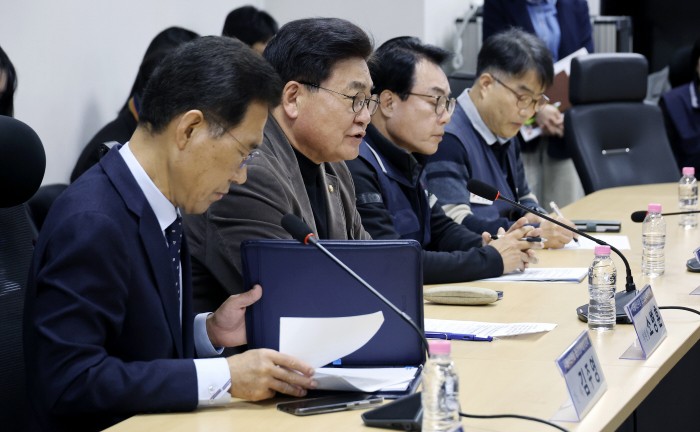 |
| Rep. So Byung-hoon, chairman of the Democratic Party of Korea's Special Committee on Retirement Age Extension, speaks at a meeting of the committee's labor-management subcommittee at the National Assembly Members' Office Building on November 27. / Yonhap News Agency |
Labor and management came together for the first time in 10 months to discuss extending the retirement age, but the gap between their positions appears to remain wide.
On November 27, the Democratic Party of Korea's Special Committee on Retirement Age Extension resumed labor-management consultations after a 10-month hiatus in an effort to reach an agreement. Speaking at a subcommittee meeting at the National Assembly, committee chairman So Byung-hoon said, “We cannot put this off any longer and must settle the matter by the end of this year. We have had ample opportunity to hear each other's views, and although the two sides' demands do not align, we have made efforts to bring them as close together as possible.”
“I hope we can reach a consensus through today's final meeting and announce a proposal today. We will have to see how the meeting concludes, but we will present a proposal in the near future,” So added.
Representing the business community at the meeting were Lee Dong-keun, executive vice chairman of the Korea Enterprises Federation (KEF), and Oh Ki-woong, executive vice chairman of the Korea Federation of SMEs (KBIZ). The labor sector was represented by Kang Seok-yoon, senior vice president of the Federation of Korean Trade Unions (FKTU), and Han Sung-gyu, vice president of the Korean Confederation of Trade Unions (KCTU).
In June, the special committee proposed a compromise plan centered on gradually raising the statutory retirement age. Under the plan, the retirement age would be raised to 61 in 2029 and increased by one year every two years until it reaches 65 in 2037. The proposal also included gradually raising the age limit for mandatory reemployment of workers who retire before the statutory retirement age reaches 65, to 61 in 2028, 62 in 2029, 63 in 2031, 64 in 2033 and 65 in 2035.
The labor sector, however, maintains that post-retirement reemployment cannot serve as an alternative to extending the statutory retirement age and insists that the retirement age should be raised uniformly.
The business community, by contrast, argues that a continued employment system should be designed primarily around post-retirement reemployment, citing labor cost burdens and the potential impact on the hiring of young workers.
“The benefits of an across-the-board increase in the retirement age would further deepen the dual structure of the labor market. Rather than being bound by a year-end legislative deadline, we must rebuild the framework for discussions to allow various stakeholders, including young people, to participate in deliberations,” Lee said at the meeting.
In response, Han said, “The business community talks about the cost burden of extending the retirement age but remains silent about the tax breaks it has received from the government. Giving back to society what businesses have received through such support is what truly demonstrates social responsibility.”
Kim Dong-min
Most Read
-
1
China President Xi's Keynote Speech at the APEC C..

-
2
Iran resumes attacks after two months, targeting U..

-
3
Russian warship sinks in suspected drone attack at..

-
4
Inside Kylin Villa, the symbol of China's reform h..

-
5
Trump, Xi, Putin call for security cooperation at..

-
6
Trump, Putin, Zelenskyy may hold peace talks at G2..

-
7
Trump, Xi pledge cooperation on Hormuz, Iran nucle..

PEOPLE






-
Address : In-Young Bldg., 34, Uisadang-daero 1-gil, Yeongdeungpo-gu, Seoul
Copyright by ASIATODAY CO., LTD. All rights resereved