



Global tech firms woo Korean chipmakers to secure memory chips
Nov 27, 2026, 10:54 am


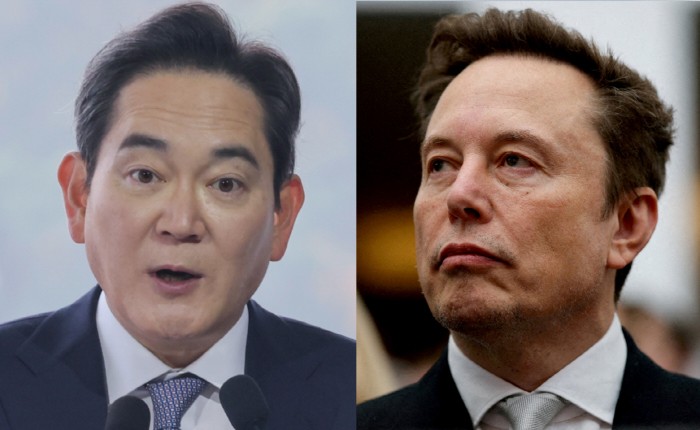 |
| Samsung Electronics Chairman Lee Jae-yong (left) and Tesla CEO Elon Musk. / Yonhap News Agency |
As expanding investment in artificial intelligence (AI) data centers drives a shortage of memory chips, global customers are offering increasingly varied terms to secure supplies from Samsung Electronics and SK Hynix. Tesla CEO Elon Musk, who has announced plans to produce chips in-house, reportedly offered Samsung Electronics Chairman Lee Jae-yong not only a long-term commitment to purchasing memory chips but also a financial guarantee for the construction of a new semiconductor plant.
The Wall Street Journal (WSJ) reported on November 27 that Musk had offered to guarantee financing for the construction of a new Samsung semiconductor plant after proposing a long-term memory chip purchase commitment. According to the report, Lee responded on both occasions that other customers were making the same offers and asked what additional terms Musk could offer. The anecdote was recounted by Carl Kawaja, a portfolio manager at Capital Group, who heard it from Musk and shared it at a conference in June.
Competition to secure memory chips is also evident in procurement operations. Some major AI companies have arranged accommodations near Samsung Electronics' semiconductor plants, stationing procurement personnel there to monitor delivery schedules daily, the WSJ reported. Marques McCammon, CEO of U.S. automaker Karma Automotive, has visited South Korea four times over the past six months to meet local memory suppliers. He said that even after meeting suppliers, it was difficult to finalize prices and delivery dates. Taiwanese memory module manufacturer Apacer has even taken out loans to purchase chips as soon as supplies become available.
As memory chip prices surge, consumers are also paying more for electronic products. Apple has raised MacBook prices by up to $500, depending on the model, while the price of the iPhone 18 Pro Max released this year is $100 higher than that of its predecessor. Apple CEO Tim Cook likened the semiconductor supply shortage to a once-in-a-century flood.
The supply shortage is unlikely to ease anytime soon. Memory chip manufacturers, including Samsung Electronics, SK Hynix and U.S.-based Micron, have experienced sharp price declines caused by oversupply following capacity expansions and must therefore carefully assess long-term demand before investing. Even if some data center construction projects show signs of slowing, the time required to bring new semiconductor plants into operation is expected to keep the market tilted in favor of suppliers for the foreseeable future.
South Korea's two major memory chipmakers have already secured supply contracts covering several years ahead. Samsung Electronics previously said during an earnings conference call that its entire supply of high-bandwidth memory (HBM) and general-purpose DRAM for next year had been sold. The company also said it had secured contracts for supplies in 2029 and was discussing long-term supply agreements lasting up to five years. SK Hynix likewise said during an earnings conference call that its entire DRAM and HBM output through 2029 had been sold.
The terms of long-term supply agreements are also changing. Peter Lee, a semiconductor analyst at Citigroup, told the WSJ that suppliers and customers, which previously relied on verbal agreements for long-term transactions, now wanted binding contracts lasting up to five years. Arrangements under which customers pay 25 to 30 percent of the purchase price upfront or cover part of the investment costs for new factories have also emerged.
Lee Ji-sun
Most Read
-
1
China President Xi's Keynote Speech at the APEC C..

-
2
Iran resumes attacks after two months, targeting U..

-
3
Russian warship sinks in suspected drone attack at..

-
4
Inside Kylin Villa, the symbol of China's reform h..

-
5
Trump, Xi, Putin call for security cooperation at..

-
6
Trump, Putin, Zelenskyy may hold peace talks at G2..

-
7
Trump, Xi pledge cooperation on Hormuz, Iran nucle..

PEOPLE






-
Address : In-Young Bldg., 34, Uisadang-daero 1-gil, Yeongdeungpo-gu, Seoul
Copyright by ASIATODAY CO., LTD. All rights resereved