



SeAH Besteel earns top zero waste to landfill rating for second consecutive year
Nov 27, 2026, 10:43 am


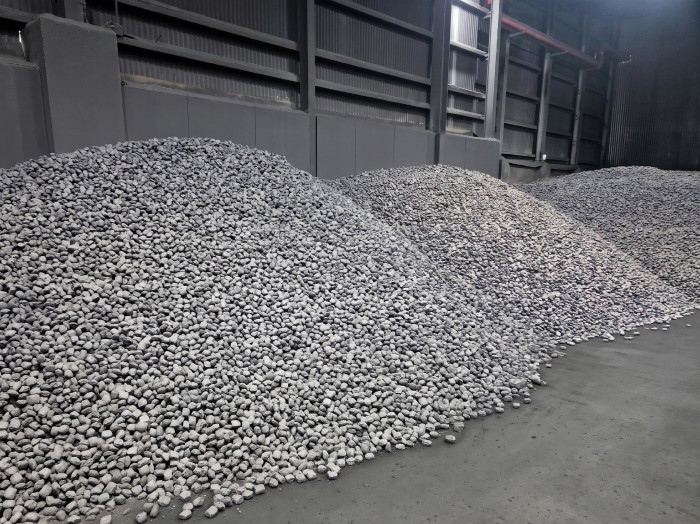 |
| Iron-bearing briquettes, made by compacting waste byproducts into raw materials for steelmaking, are stacked in a storage yard at SeAH Besteel. / SeAH Besteel |
SeAH Besteel has demonstrated its competitiveness in resource recycling by raising the recycling rate of waste generated during specialty steel manufacturing to 99.7 percent.
SeAH Besteel announced on November 27 that it had earned the Platinum rating, the highest tier of Zero Waste to Landfill (ZWTL) certification, from global safety certification organization UL Solutions. SeAH Besteel is the first South Korean steelmaker to achieve the Platinum rating for two consecutive years.
ZWTL is an international environmental certification that assesses the proportion of waste generated at business sites that is recycled or reused. Silver, Gold and Platinum ratings are awarded based on recycling rates, with the highest Platinum rating requiring an effective recycling rate of at least 99.5 percent.
As various ferroalloys are used in specialty steel manufacturing, large quantities of byproducts with varying compositions, including slag and dust, are generated. SeAH Besteel has therefore continued to develop technologies and invest in facilities to separate and process these byproducts according to their characteristics and recycle them into industrial raw materials.
A prime example is the byproduct recycling center established last year. Previously, slag generated during steelmaking was mainly used as land fill material. Since the establishment of the center, however, the company has been sorting and processing slag according to its composition and converting it into higher-value industrial raw materials. Electric arc furnace slag is used as aggregate for concrete production, while aluminum refining slag powder has been used as a raw material for ultra-rapid-hardening cement since the first half of this year.
The company has also strengthened its in-house recycling system to reintroduce iron-bearing byproducts into the production process. Scale, dust and sludge that were previously sent to external contractors for treatment are compacted into iron-bearing briquettes, known as Briquettes for Reduced Metal (BRM), and fed into electric arc furnaces as a substitute for steel scrap.
“Becoming the first South Korean steelmaker to earn the Zero Waste to Landfill Platinum rating for two consecutive years is the result of consistently maintaining a reliable resource recycling system at our specialty steel manufacturing facilities,” a SeAH Besteel official said.
Kim Yu-ra
Most Read
-
1
China President Xi's Keynote Speech at the APEC C..

-
2
Iran resumes attacks after two months, targeting U..

-
3
Russian warship sinks in suspected drone attack at..

-
4
Inside Kylin Villa, the symbol of China's reform h..

-
5
Trump, Xi, Putin call for security cooperation at..

-
6
Trump, Putin, Zelenskyy may hold peace talks at G2..

-
7
Trump, Xi pledge cooperation on Hormuz, Iran nucle..

PEOPLE







-
Address : In-Young Bldg., 34, Uisadang-daero 1-gil, Yeongdeungpo-gu, Seoul
Copyright by ASIATODAY CO., LTD. All rights resereved