



Korea expands heavy snow alerts nationwide
Nov 27, 2026, 10:25 am


 |
| An AI-generated image. |
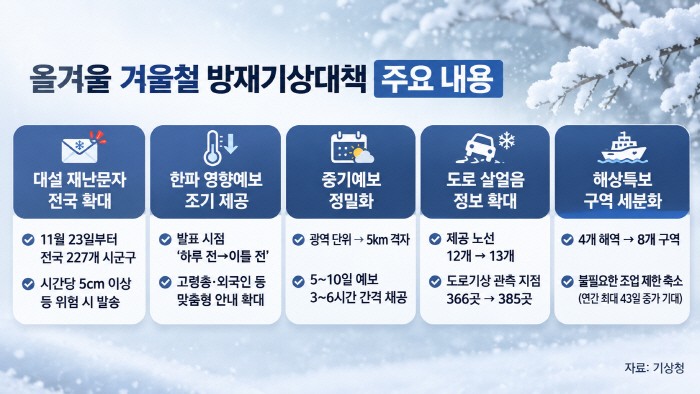
Starting this winter, heavy snow emergency text alerts will be expanded nationwide. Cold wave impact forecasts will be issued two days before the onset of cold waves, while medium-range forecasts will be provided on a 5-kilometer grid to improve the accuracy of localized weather information.
The Korea Meteorological Administration (KMA) announced its “2026 Winter Weather Disaster Prevention Measures” at a National Policy Coordination Meeting chaired by the prime minister on November 26.
The KMA expanded its heavy snow safety alerts, delivered through the Cell Broadcast Service (CBS), to 227 cities, counties and districts nationwide on November 23, following a pilot program conducted last year in areas including the greater Seoul area, South Chungcheong Province and North Jeolla Province. Alerts will be issued according to local risk conditions using data from 653 snow observation stations. When snowfall reaches 5 centimeters or more per hour, alerts will warn of the risk of traffic accidents. When fresh snow accumulation over 24 hours reaches at least 20 centimeters and hourly snowfall reaches at least 3 centimeters, alerts will warn of the risk of structural collapse. However, the fresh snow accumulation threshold will be set at 30 centimeters for Gangwon Province and Ulleung County in North Gyeongsang Province.
The KMA will strengthen its heavy snow forecasts by providing information on the likelihood of heavy snowfall two to three days in advance, using three levels: low, moderate and high. Its very short-range forecasts, which cover weather conditions within the next six hours, now include information on one-hour fresh snow accumulation, referring to the amount of new snow that accumulates over one hour.
Cold wave impact forecasts will be issued two days in advance instead of one. Starting next month, cold wave risk information will be delivered directly to older adults when the health-related impact forecast reaches the “caution” level or higher. Tailored information will be provided to foreign workers in six languages, while cold wave notifications delivered through artificial intelligence (AI) speakers will be made available to more recipients.
Medium-range forecasts will also become more precise. Forecasts previously provided for metropolitan cities and provinces will be broken down into 5-by-5-kilometer grids. Weather forecasts for five to seven days ahead will be provided at three- to six-hour intervals, while forecasts for eight to 10 days ahead will be provided at six-hour intervals. Instead of primarily indicating whether precipitation is expected, the forecasts will classify the likelihood of rain or snow into four levels: minimal, low, moderate and high. Users will also be able to check temperature changes and the likelihood of precipitation at different times of the day.
Road weather information will also be expanded to prevent winter traffic accidents. The number of routes covered by black ice risk information will increase from 12 to 13, while the number of road weather observation stations will rise from 366 to 385. Black ice risks along individual roads will be classified into three levels: attention, caution and danger.
Marine weather warning areas will be subdivided from four sea areas into eight zones, allowing weather advisories and warnings to be issued primarily for areas actually experiencing hazardous weather conditions. The KMA expects the reduction in unnecessary fishing restrictions to increase the number of available fishing days by up to 43 per year.
The KMA expects temperatures and precipitation this winter to be above normal. However, temporary influxes of cold air could cause temperatures to drop sharply and bring heavy snowfall.
“Thorough preparations are necessary given the high likelihood of hazardous weather conditions, including heavy snowfall, cold waves and strong winds, this winter,” KMA Administrator Lee Mi-seon said. “We will mobilize all our capabilities to respond, with public safety as our top priority.”
Kim Tae-hoon
Most Read
-
1
China President Xi's Keynote Speech at the APEC C..

-
2
Iran resumes attacks after two months, targeting U..

-
3
Russian warship sinks in suspected drone attack at..

-
4
Inside Kylin Villa, the symbol of China's reform h..

-
5
Trump, Xi, Putin call for security cooperation at..

-
6
Trump, Putin, Zelenskyy may hold peace talks at G2..

-
7
Trump, Xi pledge cooperation on Hormuz, Iran nucle..

PEOPLE






-
Address : In-Young Bldg., 34, Uisadang-daero 1-gil, Yeongdeungpo-gu, Seoul
Copyright by ASIATODAY CO., LTD. All rights resereved