



Constitutional Court upholds law reserving massage profession for visually impaired for sixth time
Nov 27, 2026, 10:20 am


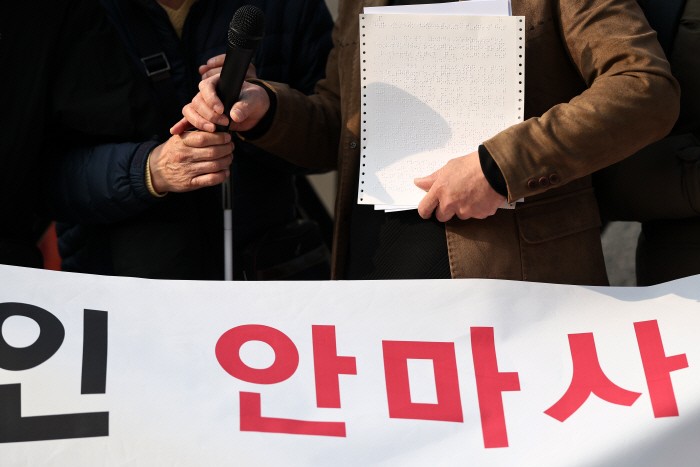 |
| A press conference calling for the Constitutional Court to uphold the constitutionality of the system reserving the massage profession for people with visual impairments takes place outside the court on November 26. / Yonhap News Agency |
The Constitutional Court has ruled that a provision of the Medical Service Act granting massage therapist qualifications exclusively to people with visual impairments is constitutional. This marks the sixth time the provision has been upheld as constitutional.
On November 26, the Constitutional Court ruled 8-1 in favor of the constitutionality of Article 82(1) of the Medical Service Act and related provisions in a constitutional complaint filed by operators of unlicensed massage establishments.
Article 82(1) of the Medical Service Act stipulates that people with visual impairments who have completed prescribed training courses must obtain accreditation from the relevant mayor or provincial governor to become massage therapists. Paragraph 3 prohibits individuals without massage therapist qualifications from opening massage clinics or parlors, while Article 88 of the same Act stipulates that anyone providing massage services for profit without the required qualifications is subject to imprisonment for up to three years or a fine of up to 30 million won.
The Constitutional Court rejected the complainants' arguments that the provisions infringed on the freedom of occupational choice and the right to equality of people without visual impairments.
“The public interests pursued by the qualification provision, including promoting the participation of people with visual impairments in economic and social life and supporting their independent living, outweigh the freedom of occupational choice of people without visual impairments,” the court said. “Promoting the economic and social participation of people with visual impairments by granting them exclusive access to the massage profession is an appropriate means of achieving the legislative purpose.”
The court added, “It is difficult to conceive of a reasonable alternative that would achieve the legislative purpose of guaranteeing the right to livelihood of people with visual impairments to the same extent as restricting massage therapist qualifications to them, while imposing fewer restrictions on the freedom of occupational choice of people without visual impairments.”
Regarding the provision restricting the establishment of massage clinics, the court also said, “If people without visual impairments were allowed to establish and operate massage clinics and similar establishments, a structure in which employers without visual impairments hire employees with visual impairments could become entrenched. This could leave massage therapists with visual impairments in welfare blind spots, where they may be forced to work under poor conditions or suffer from low wages.”
In her dissenting opinion, however, Justice Kim Bok-hyeong said, “The proportion of people with visual impairments working in the massage profession has not increased, limiting the provision's contribution to achieving its legislative purpose.”
“Despite the continued existence of the system reserving the massage profession for people with visual impairments, their level of participation in economic and social life has not improved significantly,” she pointed out.
Constitutional complaints concerning massage therapist qualifications have been filed on several occasions. However, the Constitutional Court upheld the constitutionality of the provision five times between 2008 and 2021.
Son Seung-hyun
Most Read
-
1
China President Xi's Keynote Speech at the APEC C..

-
2
Iran resumes attacks after two months, targeting U..

-
3
Russian warship sinks in suspected drone attack at..

-
4
Inside Kylin Villa, the symbol of China's reform h..

-
5
Trump, Xi, Putin call for security cooperation at..

-
6
Trump, Putin, Zelenskyy may hold peace talks at G2..

-
7
Trump, Xi pledge cooperation on Hormuz, Iran nucle..

PEOPLE






-
Address : In-Young Bldg., 34, Uisadang-daero 1-gil, Yeongdeungpo-gu, Seoul
Copyright by ASIATODAY CO., LTD. All rights resereved