



Judges begin speaking out amid push to impeach Supreme Court chief justice
Nov 27, 2026, 10:12 am


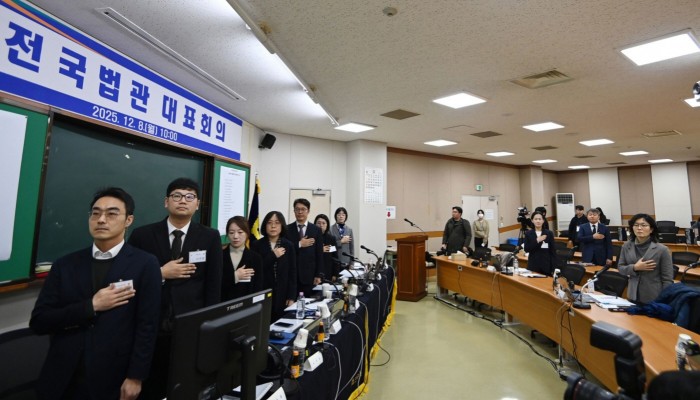 |
| Judges elected as representatives from courts at various levels salute the national flag during a meeting of the National Conference of Judge Representatives at the Judicial Research and Training Institute in Ilsan, Goyang, Gyeonggi Province, on December 8 last year. The representatives stressed the need for careful deliberation rather than rushing through the ruling party's judicial reform initiatives. / Yonhap News Agency |
Signs of change are emerging within the judiciary amid the Democratic Party of Korea's push to impeach Supreme Court Chief Justice Cho Hee-dae. Judges who have refrained from publicly expressing their positions on political pressure on the judiciary have begun speaking out. Attention is now turning to whether these concerns will translate into an official statement or resolution at the National Conference of Judge Representatives scheduled for November 30.
According to legal sources on November 26, various opinions have been voiced within the judiciary on a daily basis regarding the push to impeach Cho. On November 22, Kang Dong-won, a presiding judge at the Seoul Family Court and chair of the National Conference of Judge Representatives, posted a message on CourtNet, the judiciary's internal network, suggesting that judges should take action if an impeachment motion is passed. Since then, a series of opinions have emerged, ranging from calls for an active response over concerns about infringements on judicial independence to warnings that collective action by judges could deepen political divisions.
An official statement has also been issued at the individual court level. On November 25, the Changwon District Court held its regular general meeting of judges for the second half of the year and stated that “pursuing the impeachment of judges undermines the constitutional values of judicial independence and the separation of powers.” Several other courts are scheduled to hold their regular second-half judges' meetings in December.
Observers within and outside the judiciary suggest that growing concerns over threats to judicial independence are coming to the surface in the wake of the Democratic Party's push to impeach Cho. Judges have traditionally taken a cautious approach to speaking out against political pressure on the judiciary, given that doing so could spark controversy over the fairness of trials or the political neutrality of the judiciary. However, there appears to be a growing perception that judicial independence can no longer be protected simply by remaining silent.
“Judges have been extremely cautious about publicly expressing their views on politically sensitive issues, but there seem to be more judges who now believe that the situation can no longer be overlooked,” said a lawyer who formerly served as a judge. “There appears to be a growing consensus that judges themselves should begin taking concrete action.”
“In the past, there was a perception that the National Conference of Judge Representatives tended to amplify the voices of judges with relatively firm positions, while failing to adequately reflect the views of the majority of judges who held moderate positions or remained silent,” the lawyer added. “This time, however, a range of views are being expressed, so the conference may even consider adopting a substantive resolution.”
At a meeting held last year following the Supreme Court's decision to overturn and remand President Lee Jae-myung's case involving violations of the Public Official Election Act, five related agenda items were discussed, but all were voted down.
This time, however, with judges actively expressing their views, there is speculation that an official position could emerge from the National Conference of Judge Representatives on November 30. Although none of the agenda items submitted in advance so far concern Cho or related matters, additional items may be introduced by the chair or with the consent of at least nine judge representatives on the day of the meeting.
Son Seung-hyun
Most Read
-
1
China President Xi's Keynote Speech at the APEC C..

-
2
Iran resumes attacks after two months, targeting U..

-
3
Russian warship sinks in suspected drone attack at..

-
4
Inside Kylin Villa, the symbol of China's reform h..

-
5
Trump, Xi, Putin call for security cooperation at..

-
6
Trump, Putin, Zelenskyy may hold peace talks at G2..

-
7
Trump, Xi pledge cooperation on Hormuz, Iran nucle..

PEOPLE







-
Address : In-Young Bldg., 34, Uisadang-daero 1-gil, Yeongdeungpo-gu, Seoul
Copyright by ASIATODAY CO., LTD. All rights resereved