



S. Korea could post growth in high 3% range this year, finance minister says
Nov 23, 2026, 01:22 pm


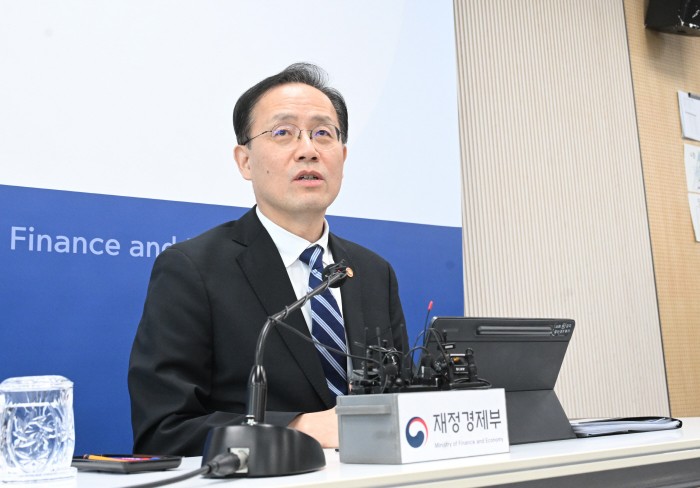 |
| Deputy Prime Minister and Minister of Finance and Economy Lee Hyoung Il delivers opening remarks at a press briefing at the Government Complex Sejong on November 23. / Courtesy of the Ministry of Finance and Economy |
Deputy Prime Minister and Minister of Finance and Economy Lee Hyoung-il said on November 23 that South Korea's economy could grow in the upper 3% range this year, as strong semiconductor exports lead to increased facility investment. However, he said the recovery in people's livelihoods has not kept pace with the broader economic improvement due to high inflation, high interest rates and sluggish youth employment, adding that next year's economic policy would focus on reducing polarization and reviving potential growth.
"Our economy has recently maintained strong growth momentum," Lee said at a press briefing at the Government Complex Sejong. "Growth in the upper 3% range appears possible." He explained that rising exports driven by the semiconductor boom have translated into increased investment, with facility investment growth expected to reach the 8% range this year, its highest level in five years. Private consumption is also improving gradually, he said. The Korea Development Institute (KDI) and the International Monetary Fund (IMF) recently raised their growth forecasts for South Korea this year to 3.8% and 3.9%, respectively.
"Exports surpassed $1 trillion annually for the first time in history on November 19, raising hopes that we could become one of the world's top four exporters this year," Lee said. South Korea rose from seventh place in global export rankings last year to fifth in the January–August period this year. The gap with the fourth-largest exporter stood at $21 billion. Lee also said the country was close to surpassing $40,000 in per capita national income and pledged to do his utmost to reach $50,000 during the current administration's term.
Lee also pointed out that the concentration of growth in semiconductors could widen disparities between industries and make the broader economy more vulnerable to external shocks. "Improvements in people's living conditions have not kept pace with the economic recovery due to high inflation and high interest rates stemming from the war in the Middle East, as well as difficulties in youth employment," he said. The government plans to develop three major livelihood initiatives covering jobs, housing and financial services for low-income households. It will also draw up measures through a task force (TF) on polarization to narrow disparities in five areas: labor, industries and businesses, regions, generations and society.
Lee forecast that solid growth would continue next year as strong exports and investment gradually spread to domestic demand. He also expected inflation to be lower than this year, supported by stable international oil prices. He identified uncertainty surrounding regulations on the artificial intelligence (AI) industry, geopolitical instability and rising global interest rates as major risks.
Starting next year, the government will increase the frequency of its economic outlook releases to three times a year to respond to changing economic conditions. Lee said fiscal policy would play an active role in investing to reduce polarization and foster future growth engines while maintaining medium- to long-term fiscal soundness. He also called on the National Assembly to pass next year's budget bill and proposed tax law revisions within the statutory deadlines so that livelihood support can be delivered on time.
Lee Ji-hoon
Most Read
-
1
AMD's Lisa Su floated as potential Nvidia successo..

-
2
China President Xi's Keynote Speech at the APEC C..

-
3
Iran resumes attacks after two months, targeting U..

-
4
Alice Huang, affair partner of Jensen Huang, repor..

-
5
Inside Kylin Villa, the symbol of China's reform h..

-
6
Xi secures fourth term as China reshuffles next-ge..

-
7
Trump, Xi, Putin call for security cooperation at..

PEOPLE






-
Address : In-Young Bldg., 34, Uisadang-daero 1-gil, Yeongdeungpo-gu, Seoul
Copyright by ASIATODAY CO., LTD. All rights resereved