



Vietnam moves to manage trade surplus amid mounting U.S. pressure
Nov 23, 2026, 01:13 pm


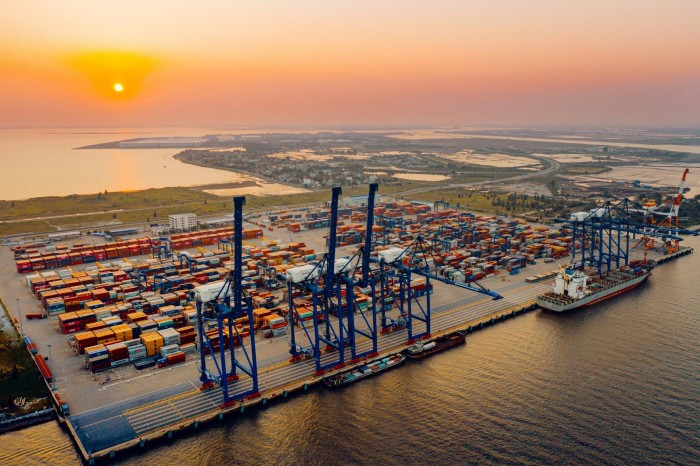 |
| Hai Phong Port in northern Vietnam. / Hai Phong Maritime Port Authority |
After Vietnam's annual trade turnover exceeded $1 trillion (approximately 1,346 trillion won) for the first time, the government has opted to manage the pace of its trade surplus rather than celebrate the milestone. With its rapidly growing trade surplus with the United States prompting mounting pressure from Washington through tariffs and trade investigations, Hanoi is seeking to eliminate grounds for retaliation by proactively tightening rules on origin verification and foreign direct investment (FDI) screening.
According to an announcement by the Vietnamese government on November 23 (local time), Standing Deputy Prime Minister Pham Gia Tuc recently signed a comprehensive plan for managing trade surpluses and preventing international trade risks for 2026–2030. The plan focuses on addressing bilateral trade imbalances and preventing illegal transshipment, overproduction and forced labor.
Behind the unusual move to manage trade surpluses lies a severe concentration of trade among a few partners. According to Vietnam Customs, the country's cumulative trade turnover reached $1.07026 trillion (approximately 1,441 trillion won) as of November 15, up 33.4% from the same period last year, but its overall trade balance shifted to a deficit of $11.74 billion (approximately 15.8 trillion won). From January through October, Vietnam recorded substantial trade deficits with China ($134.94 billion, approximately 181.7 trillion won) and South Korea ($48.63 billion, approximately 65.5 trillion won), while posting a surplus of $140.1 billion (approximately 188.6 trillion won), up 26.2%, with the United States alone. This is also why the White House identified Vietnam and other countries in August as high-risk locations for circumventing tariffs on Chinese goods and stepped up pressure by launching an overcapacity investigation under Section 301 of the Trade Act and imposing a 12.5% tariff related to forced labor.
Customs and police to share identity data to track origin relabeling
The resolution adopted by Vietnam shifts its trade response toward a data-driven system of early warnings and preventive controls. The Ministry of Industry and Trade will issue early warnings for products and companies accounting for concentrated trade surpluses. It will also replace the 2018 decree on rules of origin and link the electronic certificate of origin (C/O) system with customs, tax and investment data. The Ministry of Public Security will investigate suspected criminal cases of origin fraud and use electronic identification (VNeID) data to track tax evasion by shell companies, while the Ministry of Home Affairs will establish a legal basis for suspending customs clearance and re-exporting shipments suspected of involving forced labor.
FDI policy is also shifting from attracting investment in large volumes to selective screening and management. As of November 15, FDI companies accounted for 81.2% of Vietnam's total exports ($429.83 billion, approximately 578.7 trillion won) and generated a trade surplus of $27.4 billion (approximately 36.9 trillion won). However, domestic value added in manufacturing stood at just 12%, about one-third of the ASEAN average of 33%. Accordingly, the Ministry of Finance plans to regulate FDI inflows from the investment registration stage to prevent excessive concentration in particular markets and comprehensively review tax, land and credit incentives that could trigger disputes over overproduction and subsidies.
Korean companies accounting for 30% of Vietnam's exports also face impact
South Korean companies, which account for approximately 30% of Vietnam's exports, face both potential burdens and benefits. South Korea is Vietnam's largest investor, with cumulative investment of $98.9 billion (approximately 133.2 trillion won). Among its companies operating in Vietnam, textile and simple processing businesses that assemble products using Chinese fabrics and components for export to the United States could face greater burdens in post-clearance origin verification and proving the sources of raw materials when implementing regulations are revised. On the other hand, the measures could serve as a safeguard for major companies such as Samsung Electronics, which have established production processes and component supply networks, by helping prevent indiscriminate U.S. tariff retaliation triggered by the relabeling of Chinese goods.
Rather than immediately tightening restrictions on businesses, the resolution appears largely intended to shift U.S. trade pressure toward negotiations. Key products such as electronics and machinery are exempt from U.S. forced-labor-related tariffs, protecting more than half of Vietnam's exports to the United States. Vietnam's stronger enforcement of rules of origin also aligns with its national strategy of attracting high-value-added FDI. Earlier, Vietnamese Foreign Ministry spokesperson Pham Thu Hang said, "We will continue constructive communication on concerns raised by the U.S. side while maintaining a transparent and stable environment for investment and trade."
The future impact will depend on whether the scope of the U.S. overcapacity investigation under Section 301 of the Trade Act expands beyond traditional manufacturing industries such as apparel and furniture to electronics and advanced manufacturing. Pressure on companies operating in Vietnam to localize their supply chains is also expected to intensify as the Vietnamese government develops follow-up measures under the comprehensive plan, including legislation to replace the existing decree on rules of origin and revisions to FDI investment registration screening criteria.
Jeong Ri-na
Most Read
-
1
AMD's Lisa Su floated as potential Nvidia successo..

-
2
China President Xi's Keynote Speech at the APEC C..

-
3
Iran resumes attacks after two months, targeting U..

-
4
Alice Huang, affair partner of Jensen Huang, repor..

-
5
Inside Kylin Villa, the symbol of China's reform h..

-
6
Xi secures fourth term as China reshuffles next-ge..

-
7
Trump, Xi, Putin call for security cooperation at..

PEOPLE







-
Address : In-Young Bldg., 34, Uisadang-daero 1-gil, Yeongdeungpo-gu, Seoul
Copyright by ASIATODAY CO., LTD. All rights resereved