



Kim Jong-un receives foreign ambassadors' credentials in first such move in over 30 years
Nov 23, 2026, 10:49 am


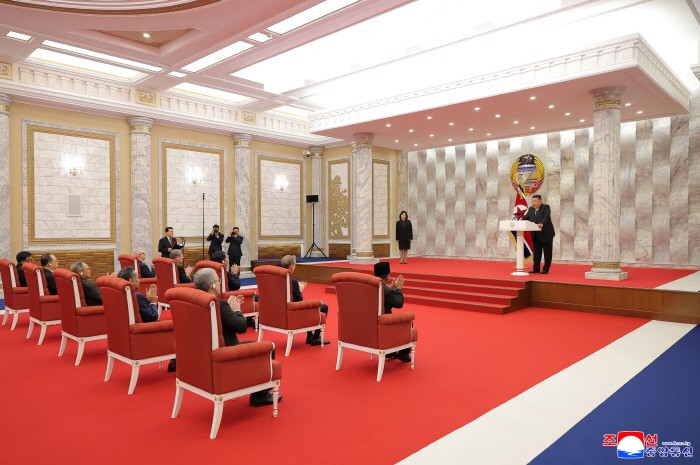 |
| North Korean leader Kim Jong-un received credentials from newly appointed ambassadors of Indonesia, Sweden, Vietnam, Russia, Brazil, the Czech Republic, India, the Philippines, Thailand and Bangladesh at the headquarters of the Central Committee of the Workers' Party of Korea on the morning of November 22. He then posed for commemorative photographs and delivered a speech, the Korean Central News Agency (KCNA) reported on November 23. Foreign Minister Choe Son-hui also attended the credential presentation ceremony, according to the agency. / Yonhap |
North Korean leader Kim Jong-un has demonstrated a shift in diplomatic protocol for the first time in more than 30 years by personally receiving foreign ambassadors. Experts analyzed the move as an official declaration of North Korea's claim to be a "normal nuclear-armed state" and an attempt by Kim to shed his previous image as a reclusive leader.
On November 23, the Korean Central News Agency (KCNA) reported that Kim had received credentials the previous day from newly appointed ambassadors of 10 countries: Russia, Indonesia, Sweden, Vietnam, Brazil, the Czech Republic, India, the Philippines, Thailand and Bangladesh.
According to KCNA, Kim delivered a speech outlining North Korea's policy direction, saying that domestically, the country prioritizes comprehensive and self-reliant national development and stable economic growth, while internationally, it seeks to expand and develop foreign relations based on the ideals of independence, peace and friendship and the principles of defending its sovereignty and security.
"I affirm that the ambassadors' diplomatic privileges and immunities will be fully guaranteed in accordance with international law and the laws and regulations of the Democratic People's Republic of Korea (DPRK)," Kim said. "At the first session of the 15th Supreme People's Assembly in March, a new government was formed in the DPRK and a new political platform was adopted. You will come to a deeper understanding that this is also in harmony with the international community's aspirations for the common prosperity of humanity and the development of international relations."
"Peace, development and prosperity are the core values of the DPRK's foreign policy. We seek neither hegemony nor expansion. High-handedness and coercion have no place in our foreign policy," Kim said. "However, we do not accept attempts to restrict or suppress the inherent rights to independence and development that all sovereign states are entitled to enjoy equally, and we will do everything to safeguard our rights and interests."
Kim's personal acceptance of credentials from foreign ambassadors is considered unusual and reflects a change under the country's revised constitution. Article 90, Paragraph 6 of the amended constitution grants the chairman of the State Affairs Commission the authority to receive credentials from foreign diplomatic representatives. Under President Kim Il-sung, the country's top leader personally received credentials from foreign ambassadors. During National Defense Commission Chairman Kim Jong-il's rule, the duty was performed by the chairman of the Standing Committee of the Supreme People's Assembly.
Experts analyzed the move as North Korea's official declaration of a new diplomatic paradigm as a "normal nuclear-armed state," bringing an end to more than 30 years of isolated, exceptional diplomatic protocol. Lim Eul-chul, a professor at the Institute for Far Eastern Studies at Kyungnam University, said, "This is a declaration that Kim intends to shed the image of a reclusive leader living in the shadow of his predecessors and actively engage in reshaping the international order. It also signals a shift toward multipolar diplomacy without being swayed by Trump's overtures."
Lim added, "The fact that North Korea invited ambassadors from 10 countries, encompassing not only friendly nations but also Western countries, U.S. allies and ASEAN countries, paradoxically suggests that a considerable number of countries are moving beyond the influence of the U.S.-led policy of diplomatic isolation and pressure against North Korea." He also assessed that "by avoiding harsh rhetoric in his speech and using the standard language of the international community, such as 'international law,' Kim is seeking to brand North Korea as a predictable, normal sovereign state."
The timing of the announcement, immediately following the Asia-Pacific Economic Cooperation (APEC) summit, is also noteworthy. Yang Moo-jin, a distinguished professor at the University of North Korean Studies, said, "Coming three days after the U.S.-China-Russia peace declaration, and considering the international attention surrounding the failure to arrange North Korea-U.S. talks on the sidelines of APEC, Kim's remarks contain an indirect response." He added, "They express North Korea's wariness of and opposition to collusion among major powers, while also sending a warning to China and Russia that Pyongyang will not tolerate any compromise with the United States that undermines its nuclear-armed status or security interests."
However, Yang added that North Korea did not appear to have closed the door to dialogue, as Kim's speech contained no direct statement rejecting talks with the United States or criticism aimed at U.S. President Donald Trump.
Lee Han-sol
Most Read
-
1
AMD's Lisa Su floated as potential Nvidia successo..

-
2
China President Xi's Keynote Speech at the APEC C..

-
3
Iran resumes attacks after two months, targeting U..

-
4
Alice Huang, affair partner of Jensen Huang, repor..

-
5
Inside Kylin Villa, the symbol of China's reform h..

-
6
Xi secures fourth term as China reshuffles next-ge..

-
7
Trump, Xi, Putin call for security cooperation at..

PEOPLE







-
Address : In-Young Bldg., 34, Uisadang-daero 1-gil, Yeongdeungpo-gu, Seoul
Copyright by ASIATODAY CO., LTD. All rights resereved